
The Role of Carbon in Steel: From Mild to Ultra-High Carbon Explained
Carbon steel is one of the most common metals you’ll find in everyday life. It holds up skyscrapers, forms car bodies, and turns into kitchen knives, gears, and railway tracks. But have you ever wondered why some steel bends easily while other steel is hard enough to cut metal? The answer comes down to one key element: carbon.
In this article, we’ll walk you through everything you need to know about carbon steel – what it is, how carbon changes its properties, the four main types, how to read steel grades, and how to pick the right one for your project. We’ll keep it clear and simple, so you’ll come away with a solid understanding of this essential material.
Table of Contents
- What is Carbon Steel?
- The Key Role of Carbon in Steel
- How Carbon Steel Is Made
- Pros and Cons of Adding Carbon
- Types of Carbon Steel
- Understanding Carbon Steel Grade Names (AISI/SAE)
- How to Choose the Right Carbon Steel for Your Application
- FAQ
What Is Carbon Steel?
According to the official definitions from SAE International and AISI (American Iron and Steel Institute), carbon steel is:
An alloy of iron and carbon, with carbon content usually no more than 2.11% by weight. It may contain small amounts of manganese (up to 1.65%), silicon (up to 0.60%), and copper (up to 0.60%), but no other metals are added on purpose.
In plain English, carbon steel is just iron + carbon, with maybe a tiny pinch of other elements. That’s it.
This is what makes it very different from stainless steel. Stainless steel needs at least 10.5% chromium to resist rust. Carbon steel has almost no chromium, so it rusts easily – but it’s also much cheaper to make.
The carbon content in carbon steel usually ranges from 0.05% to 2.11% by weight. That’s a very narrow range, but within it, three key properties change dramatically:
- Tensile strength – how much pulling force the steel can take before breaking.
- Hardness – how resistant it is to scratching or denting.
- Ductility (flexibility) – how much it can bend before it breaks.
The rule is simple: more carbon means higher strength and hardness, but less flexibility.
The Key Role of Carbon in Steel
Carbon is the most important element in carbon steel. It acts as a hardener. As carbon content goes up, the three properties change in a predictable way:
- Strength goes up.
- Hardness goes up.
- Ductility goes down.
No other element can change steel’s performance as much as carbon does. Let’s look at the numbers.
Low-carbon steel like SAE 1008 has a tensile strength of about 300 MPa, a Brinell hardness of about 80 HB, and an elongation (ductility) of up to 35%.
High-carbon steel like SAE 1095, after proper heat treatment, can reach a tensile strength of 1500 MPa and a hardness of over 500 HB – but its elongation drops to just 3–5%.
That means high-carbon steel is 5 times stronger and 6 times harder than low-carbon steel, but it’s also much more brittle.
Why does this happen? On an atomic level, carbon atoms are small enough to fit into the gaps between iron atoms. Each carbon atom creates a tiny strain field that blocks the movement of dislocations – microscopic defects that allow metal to bend. More carbon means more blocking, so bending becomes harder, but strength increases – up to a point. Beyond about 0.83% carbon, extra carbon forms a very hard but very brittle compound called cementite. That’s why the trade off is so clear: carbon gives you strength and hardness, but takes away flexibility.
How Carbon Steel Is Made
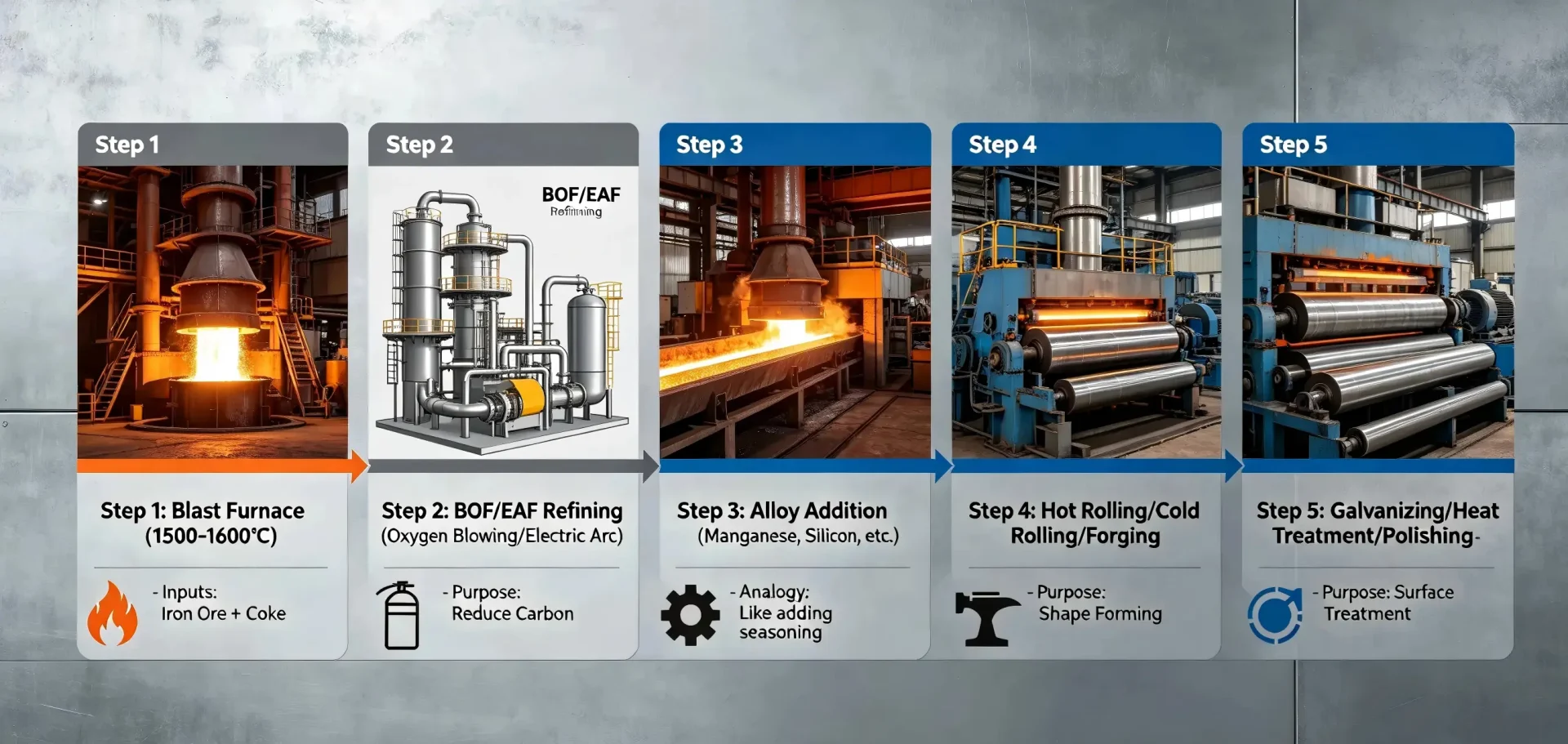
Making carbon steel is a balancing act at high temperatures. The process from raw materials to finished product has five key stages.
1. Melting the Base Materials
Iron ore, coke (a form of carbon), and limestone are heated to 1500–1600°C in a blast furnace. This produces “pig iron,” which has too much carbon (2–4%) and is too brittle for most uses.
2. Refining the Carbon Content
To get the right grade, engineers use a Basic Oxygen Furnace (BOF) – they blow pure oxygen into the liquid metal, burning off excess carbon in about 20 minutes. For custom or recycled batches, they use an Electric Arc Furnace (EAF) to melt scrap steel, which gives more flexibility.
3. Adding “Seasonings”
Precision is critical here. Automated feeders add specific elements to “season” the steel:
- Manganese – boosts overall strength.
- Silicon – removes oxygen for cleaner steel.
- Sulfur and phosphorus – added in tiny amounts to improve machinability.
4. Shaping
The steel is formed into its final shape using one of three main methods:
- Hot rolling – pressed at high temperature, used for structural beams.
- Cold rolling – done at room temperature for smooth, precise surfaces.
- Forging – shaped under massive pressure to make extra strong parts like gears.
5. Finishing Treatments
Finally, the steel gets treated for its intended environment. It may be galvanized to resist rust, polished for appearance, or given a heat treatment (annealing or quenching) to fine tune its hardness.
Pros and Cons of Adding Carbon
Adding carbon to steel brings clear benefits – but also clear drawbacks. Here’s what you gain and what you lose.
Advantages of Higher Carbon
- Strength and hardness go way up. As we saw, low carbon steel at 300 MPa becomes high carbon steel at 1500 MPa – a five fold increase. Hardness jumps from 80 HB to over 500 HB.
- Wear resistance improves. Higher carbon promotes the formation of hard microstructures like pearlite and martensite. These resist scratching, abrasion, and surface damage – which is why high carbon steel is perfect for tools, bearings, and springs.
- Better response to heat treatment. Steels below 0.30% carbon can’t be hardened by quenching. But medium and high carbon steels respond beautifully to quenching and tempering, letting you fine tune hardness and toughness for your application.
Disadvantages of Higher Carbon
- Ductility drops sharply. Elongation falls from about 35% in low carbon steel to just 3% in ultra high carbon steel. The steel becomes much more brittle.
- Weldability gets worse. According to industry standards:
- Below 0.25% carbon – easy to weld.
- 0.25% to 0.60% – harder; preheating is usually needed.
- Above 0.60% – very difficult and crack prone.
- Above 1.50% – cannot be welded by conventional fusion methods.
- Machinability may decrease. High carbon steel is harder to cut and drill. It wears out cutting tools faster, so you need slower speeds. Some grades add sulfur or lead to improve machinability, but that can hurt other properties.
- Melting point decreases. More carbon lowers the melting temperature. Ultra high carbon steel melts around 1380–1450°C, while low carbon steel melts higher. That makes high carbon steel less suitable for high temperature applications.
The takeaway: Every increase in carbon gives you more strength, hardness, and wear resistance – but it takes away flexibility, weldability, and impact toughness. There’s no free lunch. You have to choose the carbon level that fits your needs.
Types of Carbon Steel
Based on carbon content, carbon steel is divided into four main types. The table below gives you a quick overview.
| Type | Carbon % | Key Properties | Common Grades | Typical Uses |
| Low carbon (mild) | < 0.25% | Great plasticity, tough, excellent weldability, low hardness | AISI 1010, 1020, 1117, 12L14 | Car body parts, fasteners, small machined parts, welded frames |
| Medium carbon | 0.25% – 0.60% | Balanced strength and toughness, can be heat-treated | AISI 1045, 1141 | Axles, gears, bolts, construction machinery |
| High carbon | 0.60% – 1.00% | Hard, wear-resistant, less ductile, harder to weld | AISI 1070, 1085, 1095 | Springs, files, saw blades, basic knives |
| Ultra high carbon | 1.00% – 2.11% | Very hard but brittle at room temperature; normally not weldable | SAE 1151, 1170, ASTM W1, T12/T13 | Precision wear-resistant tools, high-end knives, cold-working dies, superplastic formed parts |
Now let’s look at each type in more detail.
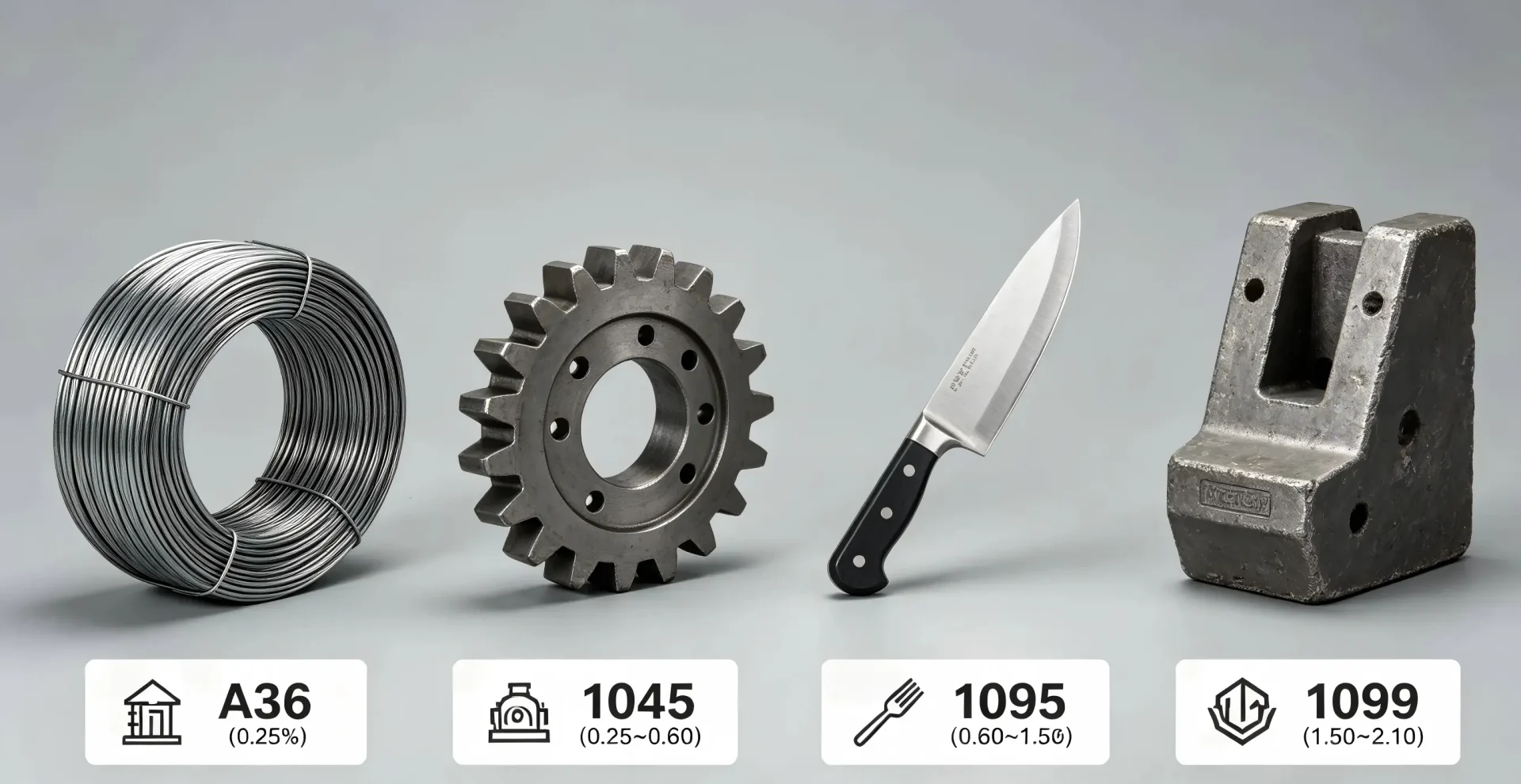
Low-carbon steel (under 0.25% carbon) is the most common type. It’s soft, bends easily, and welds like a dream. You can roll it, cut it, or shape it without cracking. Because it’s also the cheapest, you’ll find it in building frames, car panels, water pipes, and even refrigerators. A great example is ASTM A36, widely used for structural beams.
Medium-carbon steel (0.25% – 0.60%) is stronger than mild steel but still keeps some flexibility. You can heat-treat it to make it even harder. Welding? Possible, but you’ll need to pre-heat it to avoid cracks. AISI 1045 is the star here—commonly used in gears, shafts, railway tracks, and wrenches.
High-carbon steel (0.60% – 1.00%) is hard and stands up to wear. It holds a sharp edge very well, which is why it’s great for cutting tools. But there’s a catch: it’s brittle. Drop a high-carbon knife on concrete, and it might chip or break. Welding is tough too. You’ll see it in springs, files, and ball bearings. AISI 1095 is a classic knife steel, while AISI 52100 (with added chromium) is popular for bearings.
Ultra-high-carbon steel (1.00% – 2.11%) is extremely hard—but also extremely brittle. You can’t weld it in normal conditions. You won’t find it in everyday products; instead, it’s used for heavy-duty industrial tools like crusher jaws and large punches. Some high-end custom knife makers also use it for blades that need to stay sharp a very long time.
Understanding Carbon Steel Grade Names (AISI/SAE)
Now that you know the types of carbon steel, let’s talk about the labels you see on them—like 1045, 1095, or even A36.
These aren’t random. They actually tell you a story about what’s inside the steel.
What Do the Numbers in SAE/AISI Mean?
Most carbon steel grades follow the SAE/AISI system. Here’s the simple rule:
- The first two digits tell you the family of the steel.
- The last two digits tell you the carbon content—just divide them by 100 to get the exact percentage.
Let’s break down the families:
| Family | What It Means | Example |
| 10XX | Plain carbon steel – no extra additives for easy machining | 1095 = 0.95% carbon (high-carbon) |
| 11XX | Sulfur-added for better machinability | 1117 = 0.17% carbon (low-carbon) 1141 = 0.41% carbon (medium-carbon) |
| 12XX | Sulfur + lead added for even easier cutting | 12L14 = 0.14% carbon (low-carbon) |
Important tip: Don’t assume that “11XX” or “12XX” means high-carbon steel! Always look at the last two digits to know the real carbon percentage. For example, 1117 is low-carbon (0.17%), while 1170 is ultra-high-carbon (1.70%). They’re in the same family but act completely differently.
What About ASTM Grades Like A36?
Not all steel uses the SAE/AISI system. Some use the ASTM system, which focuses more on performance than chemistry.
Take ASTM A36—one of the most common structural steels.
- The “A” means it’s iron-based.
- The “36” stands for its minimum yield strength: 36,000 psi.
So A36 is a low-carbon steel (about 0.26% carbon) designed for buildings, bridges, and general construction. It’s chosen for its strength, weldability, and low cost—not because of a specific chemical recipe.
How to Choose the Right Carbon Steel for Your Application
Choosing the right steel doesn’t have to be complicated. Just follow these three simple steps to make a quick, confident decision.
Step 1. Define your main performance needs
Start by asking yourself what the steel must actually do on the job. This clears up 80% of the choice:
1.Do you need lots of welding or bending? → Choose low carbon steel. It bends easily and won’t crack during welding.
2.Do you need maximum hardness and wear resistance? → Choose high carbon steel. It stays sharp and resists rubbing wear.
3.Do you need a balanced mix of strength and toughness? → Choose medium carbon steel. It gives you good muscle without losing too much flexibility.
Once you have your main goal, move to the next step for a side by side comparison.
Step 2. Check the quick reference comparison chart
The table below shows exactly which steel type fits which application – and which to avoid. Use it as your cheat sheet for final matching.
| Carbon Steel Type | Best For | Avoid Using For | Example Grades |
| Low carbon (<0.25%) | Car stampings, standard fasteners, small machined parts, thin welded structures | Cutting tools, springs, high wear parts | AISI 1010, 1020, 1117, 12L14 |
| Medium carbon (0.25–0.60%) | Axles, gears, bolts, construction machinery | Large scale welding, sharp edges | AISI 1045, 1141 |
| High carbon (0.60–1.50%) | Springs, files, saw blades, basic knives | Structural frames, welded assemblies, impact prone parts | AISI 1070, 1085, 1095 |
| Ultra high carbon (1.50–2.10%) | Precision wear tools, high end knives, superplastic parts, cold working dies | Everyday products, welded structures | SAE 1151, 1170, ASTM W1 |
Step 3. Apply real-world logic
Still unsure? Look at these everyday examples – they make the choice obvious:
- Building a bridge or frame? Go with low carbon A36 – it welds easily and bends without cracking under load.
- Forging a kitchen knife? Pick high carbon 1095 – it holds a razor sharp edge, just remember to oil it against rust.
- Making a machine gear or shaft? Choose medium carbon 1045 – strong enough for heavy work, yet still machinable to precise shapes.
At SUMEC Metal, we help customers match the right steel to their projects every day. Whether you need low carbon for construction or high carbon for tools, our team is ready to guide you. Contact us to discuss your specific needs – we’ll save you time and guesswork.
FAQ
Q1: Is carbon steel 100% recyclable?
A1:Yes, absolutely. Scrap steel can be melted down and reused many times without losing its mechanical properties.
Q2: Is all carbon steel magnetic?
A2:Yes. Iron is the main component, and iron is magnetic. Low carbon steel is slightly more magnetic than high carbon steel, but all carbon steels are magnetic.
Q3: Does carbon content affect rust resistance?
A3:No. All carbon steels have poor corrosion resistance, regardless of carbon level. They all need coatings (like paint or galvanizing) or regular oiling to prevent rust.
Q4: How to choose the right carbon steel grade?
A4:Ask yourself three things: (1) How much strength do I need? (more carbon = higher strength) (2) How easy must it be to weld? (less carbon = easier welding) (3) What is the application – everyday items, machine parts, or special tools?
Q5: Can carbon steel withstand high temperatures?
A5:Not very well. Carbon steel loses strength at high temperatures. Ultra high carbon steel has the lowest melting point (1380–1450°C) and is not suitable for hot environments.
Conclusion
Let’s wrap it up. The role of carbon in steel comes down to one basic trade off: more carbon gives you hardness and strength; less carbon gives you flexibility and weldability. That’s the whole story.
We have four types to choose from:
- Low carbon steel – for structures and welded parts.
- Medium carbon steel – for gears and axles.
- High carbon steel – for knives and springs.
- Ultra high carbon steel – for extreme wear resistance.
And there’s one more bonus: steel is 100% recyclable. Recycling steel saves energy, reduces carbon emissions, and conserves natural resources – making it a great choice for the environment, too.
For more advice on carbon steel selection or technical support, visit our website or contact us directly. We’re always here to help you find the steel that fits your project perfectly.
Learn More About Our Products?
Contact Now