

Surface Finish in Steel: More Than Just Looks
Introduction
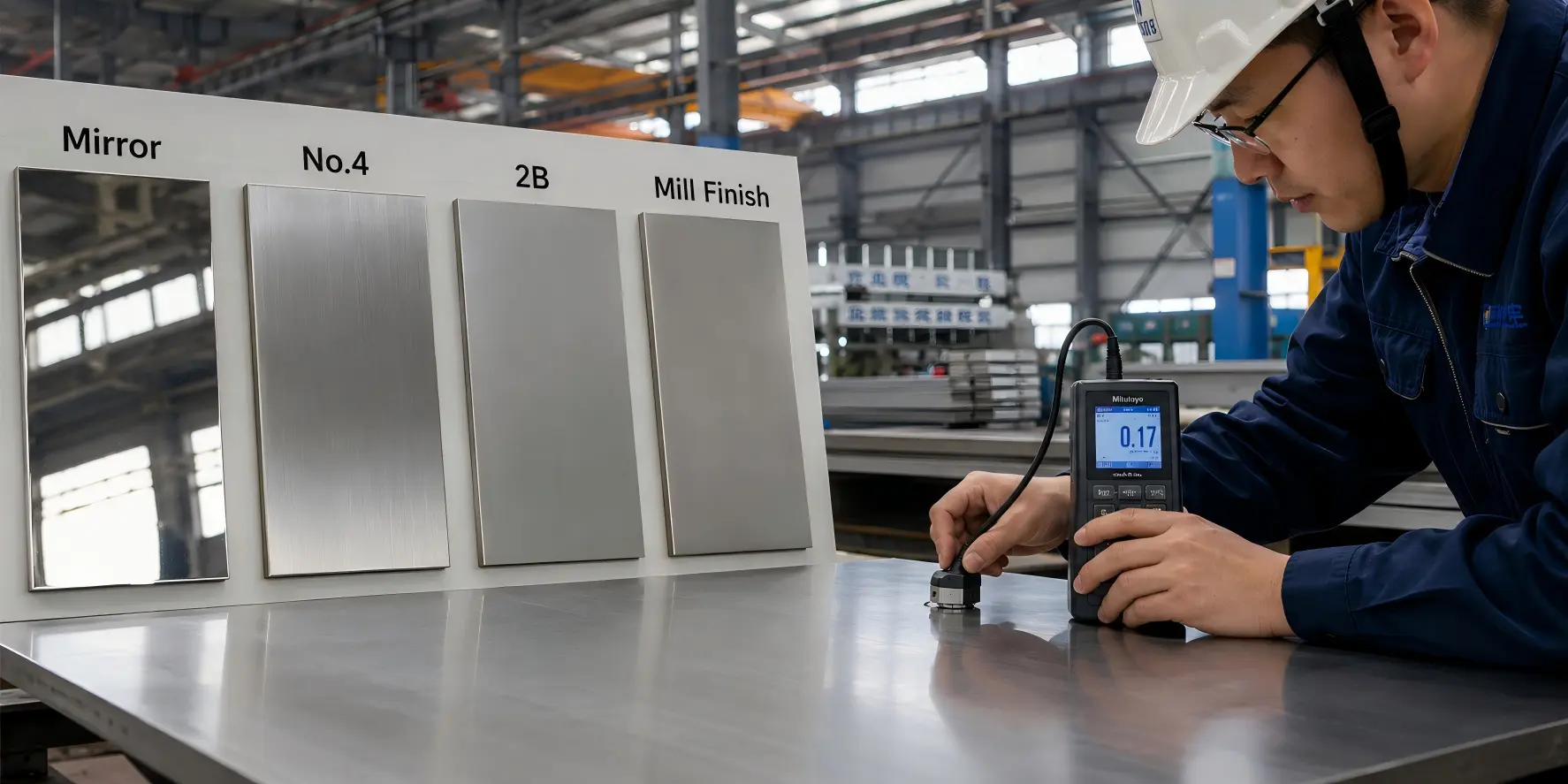
Surface finish is much more than a cosmetic feature of steel. It directly affects how a component performs in service. Surface texture influences corrosion resistance, wear behavior, fatigue life, sealing reliability, and hygiene. In many industrial applications, specifying the right surface finish is just as important as selecting the right steel grade.
Surface finish also affects downstream manufacturing. It plays an important role in welding, coating, and assembly. An unsuitable surface can lead to premature corrosion, excessive wear, leakage, poor coating adhesion, and higher maintenance costs. Choosing the right finish helps improve performance, extend service life, and reduce total lifecycle costs.
This article explains why surface finish is an important engineering consideration. It also shows how different finishes affect performance and how to choose the right finish for different applications.
What Is Surface Finish?
Surface Finish vs. Surface Roughness
Steel surfaces are never perfectly smooth. Even when a component looks flat and polished to the naked eye, microscopic inspection reveals tiny peaks and valleys. These surface features influence how steel performs in real-world conditions. They affect corrosion resistance, wear behavior, fatigue life, and sealing performance.
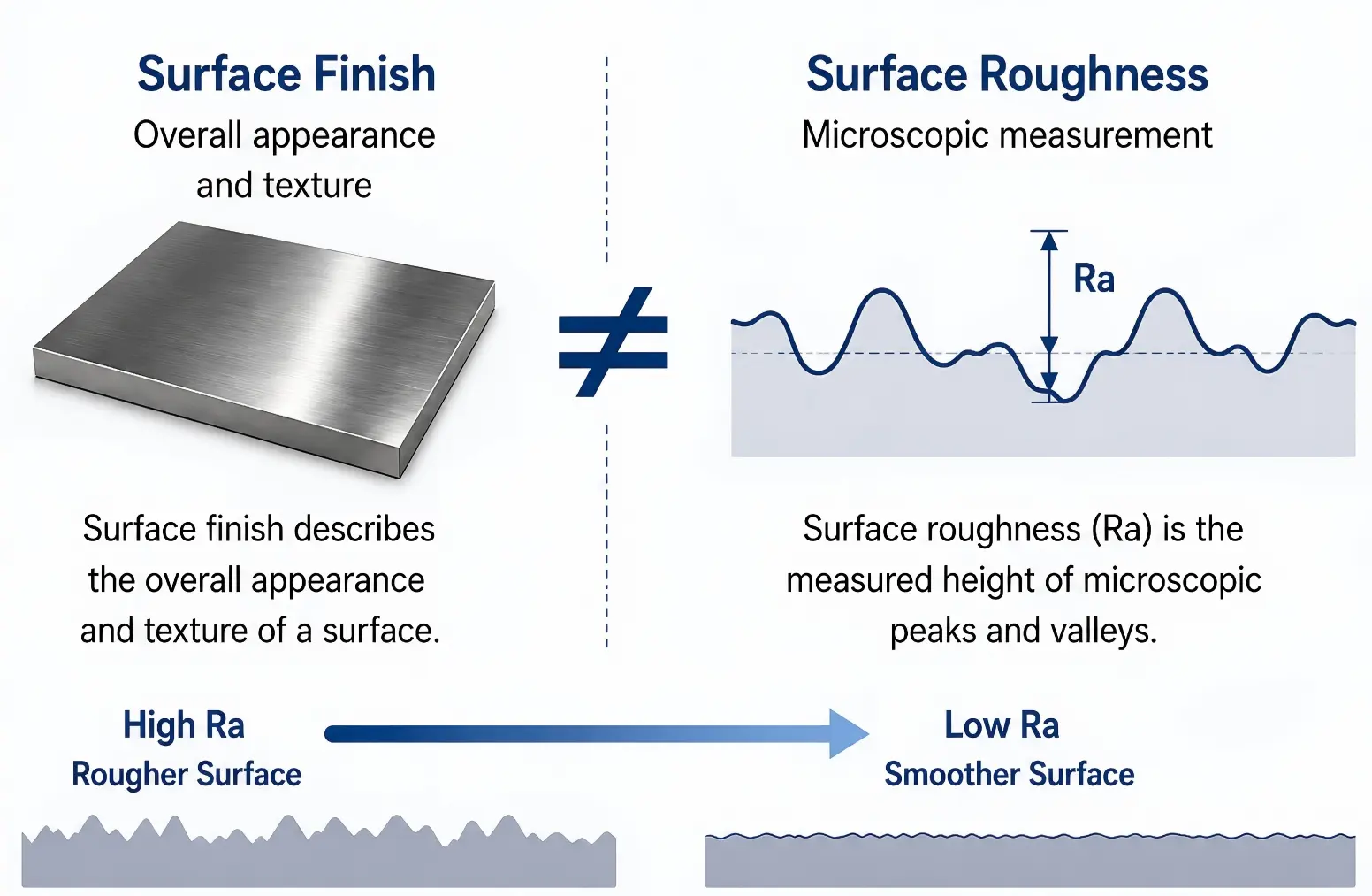
Surface finish describes the overall appearance and texture of a steel surface after manufacturing. In simple terms, it refers to how smooth or rough the surface looks and feels. Surface roughness, by contrast, is a measurable value that quantifies these microscopic variations.
The most commonly used roughness parameter is Ra (Roughness Average). It represents the average height variation of a surface profile. In general, a lower Ra value indicates a smoother surface, while a higher Ra value indicates a rougher one. The ideal Ra value depends on the application. That’s why specifying the right surface finish is an important engineering decision.
How Surface Finish Is Created
The surface finish of steel is created through a series of manufacturing and finishing processes. Each step contributes to the final texture and performance of the material.
- Hot rolling takes place at high temperatures and typically produces a rough surface with visible oxide scale.
- Cold rolling is performed at room temperature. It compresses and refines the steel to create a smoother and more uniform surface.
- Annealing and pickling remove internal stress and surface scale, leaving a cleaner and more consistent base surface.
- Grinding and brushing create controlled, uniform surface textures that improve consistency and appearance.
- Polishing and electropolishing significantly reduce surface roughness, producing smoother, higher-quality finishes.
Each process changes the steel surface at a microscopic level. These changes affect corrosion resistance, wear performance, coating adhesion, and long-term durability. That’s why surface finish is a critical factor in overall component performance.
Why Surface Finish Matters
Surface finish affects much more than how a steel part looks. It influences how the part performs throughout its service life. It affects corrosion resistance, wear, fatigue life, sealing performance, and cleanability. The right finish can improve reliability and reduce long-term costs. The wrong one can lead to premature failure and unnecessary maintenance.
The table below summarizes how surface finish influences key performance factors.
| Performance Factor | Why It Matters |
| Corrosion Resistance | Smoother surfaces trap less moisture and contamination, helping reduce corrosion. |
| Fabrication & Coating | Surface condition affects weld quality and coating adhesion. |
| Friction & Wear | Surface texture influences friction, wear rate, and component lifespan. |
| Fatigue Strength | Surface irregularities can become stress concentration points where cracks begin. |
| Sealing Performance | The right surface roughness helps seals perform reliably and prevents leaks. |
| Cleanability | Smoother surfaces are easier to clean and are less likely to retain bacteria or residue. |
Corrosion Resistance
Corrosion often begins at microscopic imperfections on a steel surface. Rougher surfaces contain more microscopic valleys where moisture, chlorides, and other contaminants can collect. These areas provide favorable conditions for localized corrosion, including pitting.
Studies on stainless steel show that polishing or electropolishing generally improves resistance to pitting corrosion by reducing these microscopic surface defects. With fewer places for harmful ions to accumulate, the passive oxide layer remains more stable over time.
This is why polished stainless steel often performs better in marine, chemical, and outdoor environments, even when the steel grade remains the same. However, the exact improvement depends on the alloy, service environment, and corrosion mechanism. Critical applications should always be validated through appropriate testing.
Fabrication, Welding, and Coating Performance
Surface finish also affects downstream manufacturing processes.
For welding, a clean and consistent surface generally produces more reliable results. Mill scale, contamination, or inconsistent surface conditions can affect weld quality and appearance.
For coatings, smoother is not always better. Paint and powder coatings often require a controlled surface texture to achieve good adhesion. That’s why many components are blasted or brushed before coating. A surface that is too smooth may reduce coating adhesion and increase the risk of premature peeling.
Friction, Wear, and Fatigue Life
For moving or load-bearing parts, surface finish directly affects mechanical performance.
Rougher surfaces create more friction where parts come into contact. This increases wear, generates heat, and shortens component life.
Surface irregularities also act as stress concentration points. Under repeated loading, fatigue cracks often begin at these locations. A smoother surface helps reduce wear and improve fatigue life. This is especially important for shafts, bearings, gears, and other moving components.
Sealing Performance
Surface finish directly affects sealing performance. However, smoother is not always better.
If a surface is too rough, microscopic gaps can allow liquids or gases to leak past the seal. If it is too smooth, some sealing systems may not achieve the surface contact needed for reliable sealing.
For this reason, flange standards specify a controlled roughness range instead of the lowest possible Ra value. ASME B16.5 specifies a surface roughness of 3.2–6.3 μm Ra for standard flange facing finishes. This range helps the gasket grip the surface while maintaining a reliable seal. Ring-type joint flanges require a finer finish of 1.6 μm Ra or less for proper metal-to-metal sealing.
Choosing the correct surface finish for the sealing method and applicable standard is essential for long-term sealing reliability.
Cleanability and Hygiene Requirements
In the food, beverage, pharmaceutical, and medical industries, surface finish is often a regulatory requirement rather than simply a design preference.
Rough surfaces trap residue, moisture, and bacteria, making equipment more difficult to clean. Smoother finishes—especially polished or electropolished stainless steel—leave fewer places for contamination to build up. As a result, cleaning becomes faster and more effective.
This is why low-roughness finishes are widely used in hygienic processing systems where cleanliness, product quality, and safety are critical.
Surface Finish and Manufacturing Cost
When a Smoother Finish Is Worth It
Additional finishing processes—such as fine polishing, electropolishing, or chemical treatment—increase manufacturing cost. However, they often provide excellent value in demanding applications.
In marine engineering, medical devices, pharmaceutical piping, and high-speed rotating equipment, surface quality directly affects reliability and service life. A smoother finish can improve corrosion resistance, reduce wear, and make cleaning easier. Although the initial cost is higher, it is often offset by lower maintenance costs and a longer operating life.
When It’s Not Worth It
Over-specifying surface finish is a common and expensive mistake. For example, specifying a mirror finish on a hidden structural bracket adds little practical value. It simply increases machining time, inspection costs, and the chance of rejected parts.
Cost does not increase in a straight line as surfaces become smoother. Instead, it rises sharply beyond a certain point. Moving from a standard finish to a moderately smoother one may only add a small amount to machining cost. Achieving an ultra-fine finish, however, can multiply manufacturing costs because it often requires additional machining passes, specialized tooling, or separate grinding and polishing operations.
Some applications also require a controlled level of roughness. Powder coating and thermal spraying rely on an anchor profile so the coating can bond securely to the surface. If the surface is too smooth, coating adhesion may be reduced, increasing the risk of premature peeling or failure.
Core Principle
The best surface finish is not necessarily the smoothest one. It is the finish that delivers the required performance at the lowest total cost over the component’s service life.
Common Surface Finish Types
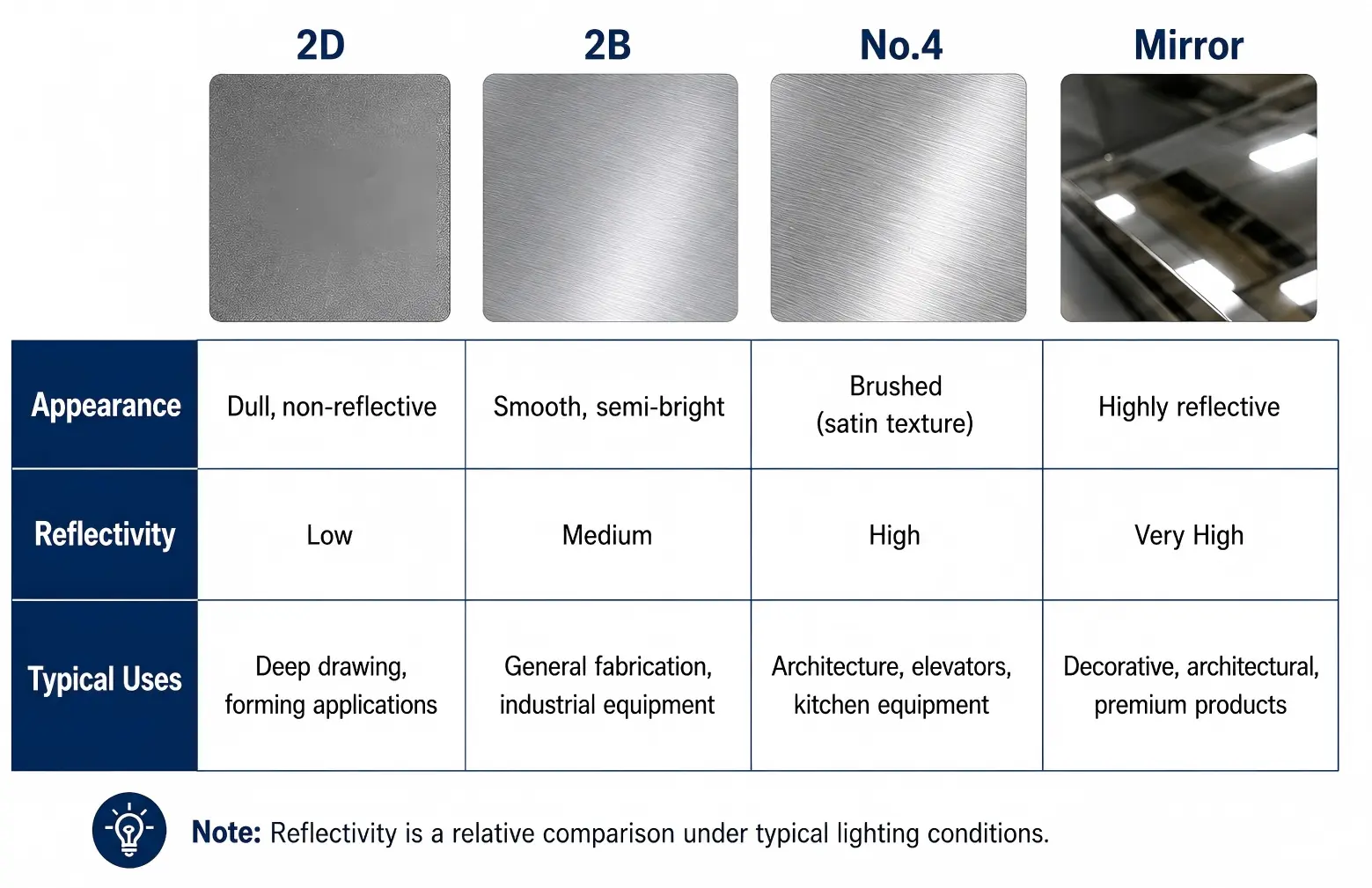
Under ASTM A480, stainless steel finishes generally fall into two main categories: mill finishes and polished finishes. Each offers a different balance of cost, appearance, and performance.
Mill Finishes (2D / 2B)
Mill finishes come directly from the rolling and annealing process with little additional treatment.
A 2D finish is cold rolled, annealed, and pickled. It has a dull, non-reflective appearance. Its non-directional texture helps retain lubricant during deep drawing and forming operations.
A 2B finish receives one additional light cold-rolling pass using polished rolls. This produces a smoother, more reflective surface than 2D. It is also easier to polish further, making it the most common starting point for higher-grade finishes.
Both finishes are widely used in general fabrication because they provide a good balance of performance and cost. However, their higher surface roughness means they may offer lower corrosion resistance than polished finishes in aggressive environments.
Polished Finishes (No. 4 / Mirror / Electropolished)
Polished finishes receive additional mechanical or electrochemical processing to further reduce surface roughness.
A No. 4 satin finish is produced with abrasive belts that create a fine, brushed texture. It is commonly used for architectural panels, elevators, commercial kitchens, and food-processing equipment because it provides an attractive appearance while hiding fingerprints and minor scratches.
A No. 8 mirror finish is created through progressively finer polishing steps. It produces the highest reflectivity and one of the smoothest surface finishes recognized under ASTM A480.
An electropolished finish is not part of the ASTM A480 numbering system. Instead, it is an additional electrochemical treatment that is usually applied to a 2B or No. 4 surface. The process removes a thin layer of material, creating an ultra-smooth surface with improved cleanliness and corrosion resistance.
These finishes are widely used where hygiene, corrosion resistance, or appearance is especially important, including food processing, pharmaceutical equipment, marine applications, and decorative architectural products.
How to Choose the Right Surface Finish
The best surface finish depends on how the part will actually be used. Instead of asking which finish looks best, ask which finish best matches the operating environment and performance requirements.
When selecting a surface finish, consider these five factors:
- Environment: Will the part be exposed to moisture, chlorides, or aggressive chemicals? Corrosive environments usually require smoother finishes.
- Performance Requirements: Moving parts, bearings, seals, and components under cyclic loading often require controlled surface roughness to improve wear and fatigue life.
- Maintenance & Cleanability: Food, pharmaceutical, and medical applications typically require smoother finishes that are easier to clean and sanitize.
- Downstream Fabrication: Consider whether the part will be welded, painted, or powder-coated. The selected finish should support those processes.
- Budget: Choose a finish that delivers the required performance without adding unnecessary manufacturing cost.
The table below provides a quick reference for common applications.
| Application | Recommended Finish | Why |
| General fabrication | 2B or 2D | Cost-effective for most industrial applications |
| Food & beverage | No. 4 or Electropolished | Easier cleaning and improved hygiene |
| Medical & pharmaceutical | Electropolished | Ultra-smooth surface with excellent cleanability |
| Architectural applications | No. 4 Satin or Mirror | Attractive appearance and good durability |
| Marine environments | Smooth 2B or Electropolished | Better corrosion resistance in chloride-rich environments |
| Decorative products | Mirror (No. 8) | Maximum reflectivity and visual appeal |
Choosing the right finish is about balancing performance, durability, manufacturability, and cost. The smoothest finish is not always the best choice.
FAQ
Q: What does Ra mean in steel surface finish?
A: Ra stands for Roughness Average. It is the most common measurement of surface roughness. It represents the average height of the microscopic peaks and valleys on a surface. In general, a lower Ra value means a smoother surface, while a higher Ra value means a rougher one. The ideal Ra depends on the application’s performance requirements.
Q: How does surface finish affect corrosion resistance?
A: Rougher surfaces trap more moisture, dirt, and chlorides, making corrosion more likely. Smoother finishes are easier to clean and help maintain a stable passive layer on stainless steel. As a result, they generally perform better in marine, chemical, and other corrosive environments.
Q: Is a 2B finish considered a mill finish?
A: Yes. A 2B finish is one of the most common stainless steel mill finishes. It is produced through cold rolling, annealing, pickling, and a light skin-pass rolling process. It provides a good balance of appearance, performance, and cost, making it suitable for many industrial applications.
Q: What’s the difference between a satin finish and a mirror finish?
A: A No. 4 satin finish has fine, brushed lines that help hide fingerprints and minor scratches. A No. 8 mirror finish is polished to produce a highly reflective surface with very little visible texture. Satin finishes are commonly used for industrial and architectural applications, while mirror finishes are mainly selected for decorative purposes.
Q: Why is surface finish important for sealing?
A: Surface finish affects how well sealing materials contact the metal surface. If the surface is too rough, microscopic gaps can allow liquids or gases to leak. Industry standards such as ASME B16.5 therefore specify controlled roughness ranges rather than the smoothest possible finish to achieve reliable sealing performance.
Conclusion
Surface finish is much more than a visual characteristic. It affects corrosion resistance, wear performance, fatigue life, sealing reliability, cleanability, and manufacturing cost. Choosing the right finish helps improve product performance, extend service life, and reduce unnecessary maintenance.
Instead of simply selecting the smoothest finish, engineers should match the surface finish to the application’s environment, manufacturing process, and performance requirements. The right specification delivers the best balance of performance, durability, and cost.
Optimize Your Material Selection with SUMEC Metal
Selecting the right surface finish requires an understanding of both material properties and real-world applications. At SUMEC Metal, we help customers choose steel materials and surface finishes that balance performance, manufacturability, and cost.
Whether you’re sourcing stainless steel for industrial equipment, food processing, marine applications, or custom fabrication, our engineering team can recommend the most suitable material and surface finish for your project.
Contact SUMEC Metal today to discuss your application or request technical support from our specialists.
Learn More About Our Products?
Contact Now