

FRP Rebar vs Steel Rebar: Cost, Strength and How to Choose for Your Project
Steel rebar is still the default choice for most concrete structures, while FRP rebar wins in a narrow set of jobs: marine walls, de-icing salt zones, and rooms that must stay non-magnetic. The gap comes down to stiffness, ductility, code support, and price.
This guide compares FRP rebar vs steel rebar across tensile strength, elastic modulus, corrosion, weight, fire behavior, and life-cycle cost. It draws on published standards such as ASTM D7957, ACI 440.11-22, ASTM A615, and BS 4449, plus the daily sourcing experience of the SUMEC Metal technical team, which has supplied steel to more than 120 countries since 1978. Readers will finish with a clear rule for picking the right bar.
What Is FRP Rebar?
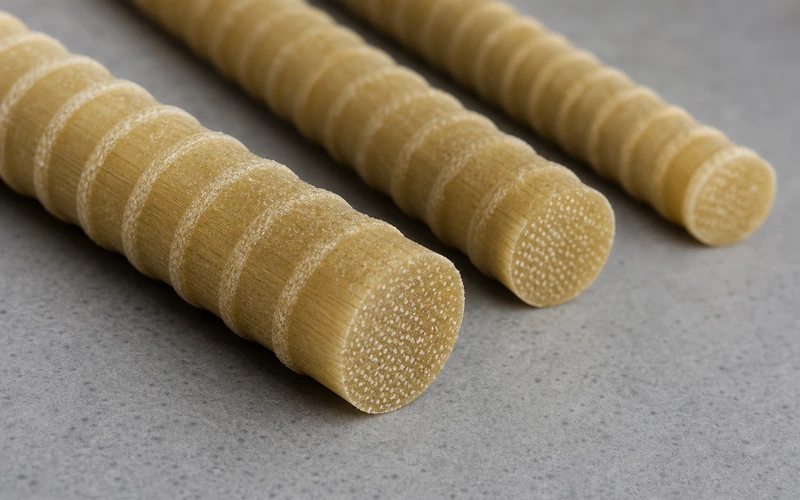
FRP rebar is a reinforcing bar made from fibers held inside a hardened resin. FRP stands for fiber reinforced polymer. Makers pull the fibers through a resin bath and a heated die, a process called pultrusion. The bar leaves the die as a straight, solid rod.
The fiber type sets the grade. The main types are GFRP (glass), BFRP (basalt), and CFRP (carbon). GFRP is used most often because it costs the least.
FRP rebar does not rust. It also carries no electric current and holds no magnetic charge. Its surface is coated with sand or wrapped with a helical rib so that the concrete can grip it.
One trait surprises many buyers. The bar stays elastic right up to the moment it snaps. It does not stretch or sag first. Design rules for FRP therefore differ from steel design rules in several places, as shown below.
What Is Steel Rebar?
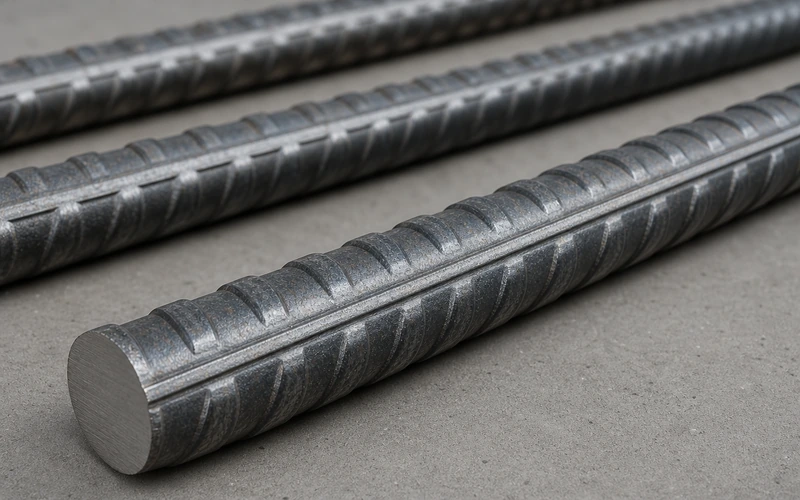
Steel rebar is a hot-rolled carbon steel bar with ribs on its surface. The ribs lock the bar into the concrete. Mills roll it to well-known grades, e.g., ASTM A615 Grade 60, BS 4449 B500B, and JIS SD390. Grade 60 has a minimum yield strength of 420 MPa.
Steel rebar has an elastic modulus of about 200 GPa. It also yields before it breaks. That yield gives a structure a visible warning. Cracks widen and the member sags before anything fails.
The material is easy to work with. Crews can cut it, bend it on site, and weld it when the grade allows, e.g., ASTM A706. Its thermal expansion is close to that of concrete, so the two move together as temperatures change.
Steel rebar is also fully recyclable, and scrap holds real market value. Suppliers list reinforcing bar in diameters from 6 mm to 50 mm, inside a wider carbon steel range that also covers coils, plates, and wire rods.
FRP Rebar vs Steel Rebar: Side-by-Side Comparison
The two bars differ in far more places than corrosion alone. The table below sets out twelve properties that shape design, budget, and site work, with typical values for each material. Figures are typical ranges, and exact values depend on bar size, resin system, and steel grade.
| Property | FRP Rebar (GFRP) | Steel Rebar (Grade 60 / B500B) |
| Tensile strength | 480–1,000 MPa, falling as bar size rises | 420 MPa yield, about 620 MPa ultimate |
| Elastic modulus | 40–60 GPa | About 200 GPa |
| Failure behavior | Elastic, then sudden rupture | Yields first, gives warning |
| Density | 1,900–2,100 kg/m³ | 7,850 kg/m³ |
| Corrosion resistance | Does not rust | Rusts once chlorides or carbonation reach the bar |
| Thermal expansion | 6–10 ×10⁻⁶/°C along the bar; 21–23 across it | About 12 ×10⁻⁶/°C, close to concrete |
| Heat resistance | Resin softens above 100–130 °C | Holds most strength to about 400 °C |
| Magnetic and conductive | No and no | Yes and yes |
| Field bending | Not possible; bends made in the factory | Yes, with standard benders |
| Welding | Not possible | Yes with weldable grades, e.g., ASTM A706 |
| Price per meter | Usually higher than steel of the same diameter | Lower, and priced per ton on an open market |
| Main standards | ASTM D7957, ACI 440.11-22, CSA S807 | ASTM A615/A706, BS 4449, GB/T 1499.2 |
Six of these twelve lines change budgets and schedules the most. Each one is unpacked below.
Strength and Stiffness
FRP rebar has higher tensile strength than steel rebar, yet it is not the stiffer bar. GFRP reaches 550–1,000 MPa in tension in common sizes, while Grade 60 steel yields at 420 MPa. Stiffness tells a different story. GFRP has a modulus of 40–60 GPa. Steel sits near 200 GPa, three to five times higher.
Stiffness controls deflection and crack width. Most slabs and beams are limited by these service checks, not by raw strength. A designer using GFRP often has to add bar area or tighten spacing to meet the same deflection limit. That extra material can erase the strength advantage seen on paper.
Steel also holds two edges that FRP cannot match: shear strength across the bar and ductility. Ductile members bend, warn, and absorb energy before they fail.
Corrosion Resistance and Service Life
FRP rebar does not corrode, and this is its clearest advantage. Steel rebar rusts only when chloride ions or carbonation reach the bar. Rust then expands, and that pressure cracks and spalls the cover concrete.
Corrosion is a function of the environment, not a fixed fate. Dry inland structures with correct cover and low-permeability concrete routinely serve fifty years or more. Marine splash zones, bridge decks treated with de-icing salt, and wastewater plants sit at the other end of the scale.
Two design controls decide most of the outcome: cover depth and water-cement ratio. A protected bar is a third route. Galvanized, epoxy-coated, and stainless reinforcement each raise the chloride level needed before rust can start.
Weight, Fabrication and Site Installation
FRP rebar weighs about one quarter as much as steel rebar of the same size, which speeds up handling. GFRP density is near 2,000 kg/m³ against 7,850 kg/m³ for steel. Crews can carry longer bundles by hand, and freight volume drops.
Site flexibility moves the other way. FRP bars cannot be bent on site, so every hook and stirrup must be ordered in its final shape. A late design change means a new production run and a new shipping cycle.
FRP also cannot be welded. Later inspection changes too, because an electromagnetic cover meter cannot find a non-metallic bar. Crews must use ground-penetrating radar instead. Steel rebar keeps all of these site options open.
Unit Price vs Total Lifecycle Cost
Steel rebar costs less to buy, and FRP rebar is sold on the promise of a lower cost over time. Both claims can be true, depending on the numbers used.
Life-cycle cost adds the purchase price to the discounted value of future maintenance and repair, then subtracts the scrap value at the end. Three inputs drive the result: the discount rate, the design life, and the expected repair schedule.
The pattern is simple. A high discount rate or a short design life pushes future repairs toward zero in today’s money, and steel wins. A fifty- to hundred-year asset in a salt-heavy setting reverses that, and FRP can win. Steel also carries a scrap value at demolition, which enters the model as a positive figure. FRP has none.
Design Codes and Standards
Steel rebar has the deeper code base, and FRP is still catching up. Steel is covered by mature product standards in every major market. Full FRP design provisions arrived much later, with ACI 440.11-22 in the United States. The table below lists the main documents by region for each material.
| Region | FRP rebar | Steel rebar |
| United States | ASTM D7957, ACI 440.11-22 | ASTM A615, ASTM A706 |
| Canada | CSA S807, CSA S806 | CSA G30.18 |
| Europe | fib Bulletin 40 (guidance) | BS 4449, EN 10080 |
| China | GB/T 26743 | GB/T 1499.2 |
Local approval also adds time. Reviewers and designers meet FRP far less often, so submittals can sit longer in review.
Fire and Temperature Performance
Steel rebar performs better than FRP rebar in fire. The resin that binds FRP fibers softens above its glass transition temperature, which sits near 100–130 °C for common vinyl ester resins. Bond to the concrete drops off first, well before the fibers themselves fail.
Steel keeps most of its strength up to about 400 °C and loses roughly half by 600 °C. Concrete cover buys time for both materials, but only steel has decades of tested fire-rating data behind it. For buildings with a required fire rating, e.g., parking structures, hospitals, and schools, this gap often settles the choice on its own.
When to Choose FRP Rebar and When Steel Rebar Is the Better Choice
The right answer follows the exposure class and the structural demand, not a general ranking. The two lists below match each material to the project types where it performs best.
Projects suited to FRP rebar:
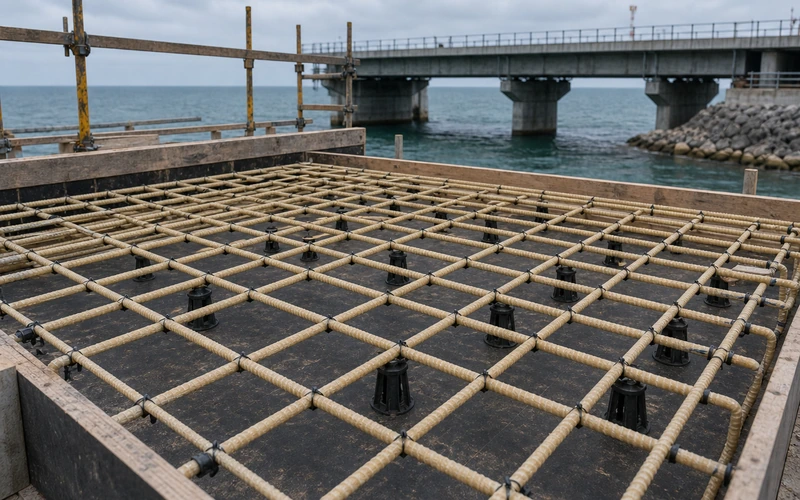
- Sea walls, piers, and other marine structures in the splash zone
- Bridge decks and parking decks exposed to de-icing salt
- Wastewater plants and chemical processing facilities
- MRI suites, testing laboratories, and other rooms that must stay free of magnetic interference
- Tunnel soft-eye walls that a boring machine has to cut through
Projects where steel rebar remains the right call:
- Tall buildings and any structure in a seismic zone, where ductility absorbs energy
- Heavy-duty industrial floors and deep foundations
- Connections that must be bent on site or welded
- Large, fast-moving projects that need volume supply and short lead times
- Cost-sensitive work where exposure is mild and cover can be controlled
- Members that carry a required fire rating
Most projects fall into the second list. That is why steel rebar still holds the default position worldwide.
FRP Rebar vs Steel Rebar: Frequently Asked Questions
Buyers raise the same six points in most enquiries, and short answers follow below.
Is FRP rebar stronger than steel rebar?
In tension, yes. GFRP reaches 550–1,000 MPa against 420 MPa yield for Grade 60 steel. But FRP is far less stiff, so members often need more bar area to pass deflection checks.
Can FRP rebar fully replace steel rebar?
No. FRP cannot be bent or welded on site, gives no yield warning, and loses bond above about 100 °C. Seismic frames, welded connections, and fire-rated members still need steel.
Why can’t FRP rebar be bent on site?
The resin is already cured and set. Bending a cured bar breaks the fibers inside it. Every hook and stirrup must be shaped in the factory before the resin hardens.
Is FRP rebar cheaper than steel rebar?
Not at purchase. FRP usually costs more per meter than steel of the same diameter. It can cost less across fifty years or more in high-chloride settings, where repairs would otherwise be frequent.
Which rebar performs better in seismic zones?
Steel rebar. Seismic design relies on ductility, and steel yields and absorbs energy before it breaks. FRP stays elastic and then ruptures suddenly, giving no warning.
How long does steel rebar last without corrosion protection?
Fifty years or more in dry inland conditions with proper cover. In marine splash zones or de-icing salt areas, rust can begin within ten to fifteen years.
Conclusion
Three rules cover most decisions. First, pick the material by exposure class, since FRP earns its price only where chlorides are constant or magnetic neutrality is required. Second, run the cost over the real design life, because a short life or a high discount rate favors steel. Third, check site flexibility early, since FRP freezes every bend at the order stage.
Steel rebar remains the default for most concrete work. It is stiffer, ductile, weldable in the right grades, backed by mature standards, and available worldwide at short notice. For grade selection, specification checks, or supply questions on rebar and related carbon steel products, readers can reach the SUMEC Metal team here.
Learn More About Our Products?
Contact Now