

Steel for Construction: Structural Grades, Rebar, and Cladding Materials
Steel for construction covers three material groups with three different jobs. Structural steel grades carry load in beams and columns. Rebar gives concrete the tensile strength it lacks. Cladding materials protect the building envelope from water, wind, and rust. Each group is chosen by a different rule, so one grade never fits all three.
This guide draws on published standards from ASTM, EN, and GB, plus common practice among mills, fabricators, and steel suppliers. It explains how to read a grade name, how grades compare across standards, how to match rebar and coated steel cladding to a site, and what to check before an order ships.
The Three Roles Steel for Construction Plays: Frame, Reinforcement, and Envelope
Steel for construction is best understood by job, not by product name. A building uses steel to stand up, to hold concrete together, and to keep weather out. Mixing up these three roles is the most common source of specification errors.
The table below sums up what each group does and which property drives the choice.
| Role | Common products | Main property that decides the choice |
| Frame | H-beams, I-beams, angles, channels, plates | Yield strength, impact toughness, weldability |
| Reinforcement | Deformed bar, coiled rebar | Yield strength plus corrosion protection |
| Envelope | Galvanized, Galvalume, ZAM, and prepainted coils | Coating mass, paint system, formability |
Each of the three runs on its own rule, so each needs its own line on the purchase order.
Structural Steel Grades for Construction: What the Numbers Mean
Structural steel grade names are short codes that state minimum yield strength. In Q355B, the “Q” stands for yield, “355” means a minimum yield strength of 355 MPa in thin sections, and “B” is the quality class. S355 works the same way under EN 10025-2. In American practice, A572 Grade 50 means a minimum yield of 50 ksi, which is about 345 MPa.
The letter at the end is where most buyers slip. It does not add strength. It sets the temperature for the Charpy impact test. S355JR is tested at +20 °C with a minimum of 27 J. Q355B is tested at +20 °C with a minimum of 34 J under GB/T 1591-2018. S355J0 is tested at 0 °C, and S355J2 at −20 °C. Two sections can share the same strength and still behave very differently in cold weather.
Common Structural Steel Grades Across ASTM, EN, and GB Standards
Most projects meet the same handful of grades, written three different ways. The list below pairs the grades that sit closest to each other in strength.
- Mild grades: ASTM A36 (250 MPa), EN S235 (235 MPa), and GB Q235
- Mid grades: EN S275 (275 MPa) and its regional equivalents
- High-strength grades: ASTM A572 Gr.50 and A992 (345 MPa), EN S355 (355 MPa), and GB Q355
- Extra-high grades: EN S420 and S460, and GB Q420 and Q460
A992 deserves a note. It is the standard grade for wide-flange shapes in the United States, with a minimum yield of 345 MPa and a minimum tensile strength of 450 MPa. That puts it close to S355 in both strength and ductility. Still, “close” is not “the same.” Equivalence tables help a buyer plan and budget, but only the design engineer of record can approve a swap. Chemistry limits, carbon equivalent, and test temperature all differ slightly between standards, and those details show up during inspection. Most of these grades are supplied as hot-rolled sections, bars, and plates, which is where the mill test certificate should be checked first.
How to Match Structural Steel Grades to Span, Climate, and Fabrication
Three questions settle almost every frame decision. Answering them in order keeps the choice simple and defensible.
First, how heavy is the load and how long is the span? Longer spans and heavier floors favour S355, Q355B, or A572 Gr.50, because a stronger grade allows lighter sections. Second, how cold does the site get? Warm and humid regions can work with a JR or B class. Cold climates and fracture-critical joints usually call for J2, K2, or a normalised grade. Third, how much welding happens on site? Heavy field welding favours a grade with tight carbon-equivalent control, since that lowers the risk of cracking near the weld.
Rebar for Construction: Grades, Sizes, and Corrosion Protection
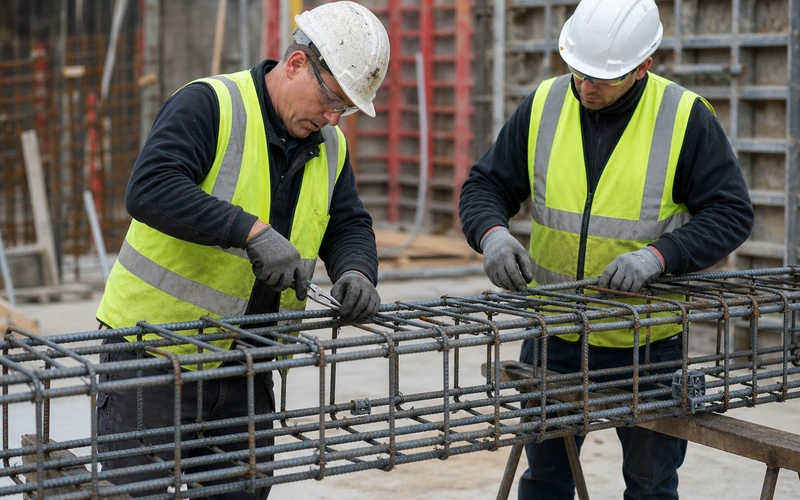
Rebar is the tension partner of concrete. Concrete is strong in compression but weak in tension, so steel bars are cast inside it to take the pulling forces. Ribs on the bar surface lock it into the concrete and stop slipping. Steel and concrete also expand at a similar rate when temperature changes, so the two materials work as one body.
Rebar selection runs on two separate tracks. Strength grade answers “how much load.” Corrosion protection answers “how long.” A higher grade does not make a bar last longer in salty air, and a coating does not raise yield strength. Treating these as one decision is a frequent and costly mistake.
Rebar Grades and Sizes on the Drawing
Rebar grades name the minimum yield strength, just like structural grades. The main systems below cover most international projects.
- ASTM A615: Grade 40, 60, 80, and 100, where the number is yield strength in thousands of psi
- ASTM A706: a low-alloy weldable bar with a controlled carbon equivalent, used where bars must be welded
- European practice (EN 10080 with BS 4449): B500B and B500C, both at 500 MPa, with B500C offering higher ductility for seismic design
- GB/T 1499.2: HRB400 and HRB500, at 400 MPa and 500 MPa
Diameters usually run from 6 mm to 40 mm, or from #3 to #11 in imperial sizes. Bars are supplied straight in bundles or in coils, and the choice affects cutting waste and site handling.
Choosing Rebar Coatings for Corrosive Construction Environments
Exposure decides the coating, and the budget decides how far to go. The four options below move from lowest first cost to longest service life.
Plain carbon rebar is the default for foundations, slabs, and columns in normal conditions. Concrete cover does most of the protection work here, so a dry indoor frame rarely needs anything more. Hot-dip galvanized bar to ASTM A767 adds a zinc layer, usually around 1,000 g/m², and suits mild coastal air or roads treated with de-icing salt. Epoxy-coated bar to ASTM A775 resists chloride well and carries a film only about 130 to 300 µm thick. That film scratches easily, so storage, bending, and placing all need care, and damaged spots must be patched before the pour. For extreme marine exposure, some projects specify stainless bar to ASTM A955, though its cost usually limits it to structures where repair access is poor. The right answer is the one with the lowest whole-life cost, not the lowest tonne price.
Cladding Materials for Construction: Coated Steel for the Building Envelope
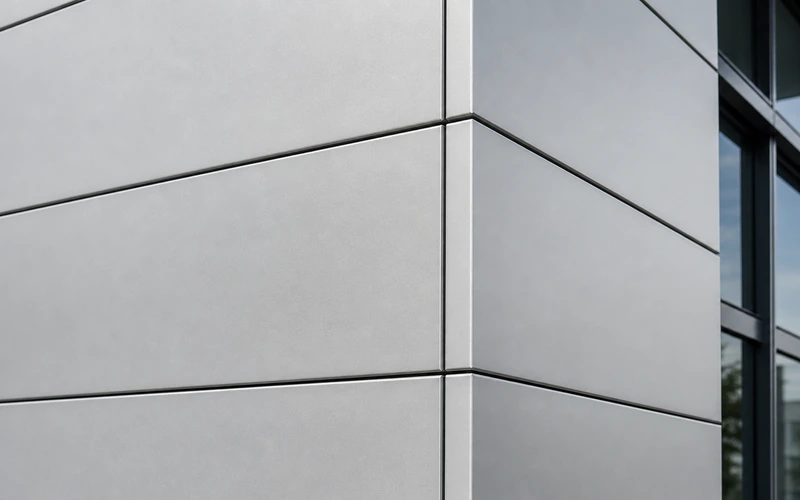
Cladding materials form the skin of a building. They shed rain, resist wind, slow corrosion, and set the visual character of the façade. For steel cladding, performance comes from three stacked layers: the steel base, the metallic coating, and the paint system on top.
Reading a cladding spec means reading all three layers, not just the panel profile. The coating mass, written as a Z or AZ number in grams per square metre, usually tells more about service life than the panel shape does.
Coated Steel Cladding Materials: GI, Galvalume, ZAM, and Prepainted Coil
Four coated products cover most roof and wall work. Each one trades cost against corrosion life.
- Galvanized steel (GI): a zinc coating, typically ordered from Z100 to Z275, used for purlins, decking, and general wall sheets
- Galvalume steel (GL): a coating of about 55% aluminium, 43.4% zinc, and 1.5% silicon, which gives strong corrosion and heat resistance for roofing
- Zinc-aluminium-magnesium (ZAM): a magnesium addition that improves cut-edge protection, useful where panels are sheared on site
- Prepainted coil (PPGI and PPGL): a coated base with a factory paint film, where polyester suits inland projects and PVDF holds colour longer in strong sun
These products are usually bought as coated and plated steel coils and roll-formed close to the site, which keeps freight cost and panel damage down.
Matching Cladding Materials to Building Type and Exposure
Building type narrows the field quickly. Once the type is set, the local climate finishes the job.
Industrial sheds and warehouses often use single-skin GI or Galvalume sheets, because speed and cost matter more than finish. A Z275 zinc coating is a common baseline for walls in a dry inland climate. Cold stores and food plants need an insulated wall build-up, where prepainted coil serves as the facing sheet over the insulation core. Commercial façades lean on prepainted coil in a PVDF system, where colour stability over ten to twenty years is part of the design. Coastal and high-humidity sites need a heavier coating mass, and salt spray within a few kilometres of the shore is enough to justify the upgrade. Fastening also matters: exposed fasteners are cheap and fast, while concealed clips give a cleaner face and fewer leak paths.
Specifying Steel for Construction: A Sourcing Checklist That Prevents Rework
Most disputes on a steel order trace back to a missing line in the specification, not to the mill. Quoting a grade without its quality class, or comparing cladding prices per tonne while ignoring coating mass, causes the most rework. The checklist below closes those gaps.
- State the grade with its quality class, such as S355J2 rather than S355 alone.
- Ask for a mill test certificate to EN 10204 3.1, and name any third-party inspection.
- For coated products, fix the coating mass, paint thickness, and colour reference.
- For rebar, confirm chemistry and carbon equivalent if welding is planned.
- Agree on batch consistency, since colour and mill origin can shift between batches.

FAQs
Is Q355B the same as S355JR?
No, they are close but not identical. Both are tested at +20 °C and share a 355 MPa yield. Q355B requires 34 J, S355JR requires 27 J, and chemistry limits differ slightly.
Which rebar grade suits seismic construction?
Grades with high ductility, such as B500C or ASTM A706, are usually preferred. They stretch further before breaking, which helps a frame absorb energy during an earthquake without sudden failure.
How long does coated steel cladding last near the coast?
Service life depends mainly on coating mass and paint system, not panel shape. Heavier zinc or Galvalume coatings with a PVDF topcoat perform best in salt air and strong sunlight.
Which documents should arrive with a construction steel shipment?
A mill test certificate, a packing list, and dimensional records at minimum. Coated products should also carry coating mass and colour data, plus any third-party inspection report the contract requires.
Conclusion
Choosing steel for construction is really three decisions in sequence: a structural grade for the frame, a rebar grade and coating for the concrete, and a cladding material for the envelope. Read the grade code, read the quality class, and read the coating mass. Then write all three into the specification with the test documents named. Buyers who compare full material data instead of tonne prices tend to avoid rework later. Specification questions that sit between two standards are usually worth settling before an order is placed, and they can be raised with a steel supply team at the sourcing stage.
Learn More About Our Products?
Contact Now