

Martensitic vs. Ferritic Stainless Steel: A Head-to-Head for High-Strength Applications
Introduction
Martensitic and ferritic stainless steels are two widely used families within the 400 series. Both are magnetic and chromium-based. But they are built for very different jobs.
Martensitic grades are known for high hardness and strength after heat treatment. This makes them a good fit for wear-resistant parts and high-load components. Ferritic grades are valued for corrosion resistance, formability, and lower cost. This makes them a popular choice for many industrial and commercial uses.
The right choice depends on a few factors: strength needs, the service environment, fabrication requirements, and budget.
In this guide, we compare martensitic and ferritic stainless steels. We look at microstructure, mechanical properties, corrosion resistance, weldability, cost, and typical applications — so you can choose the right material for your project.
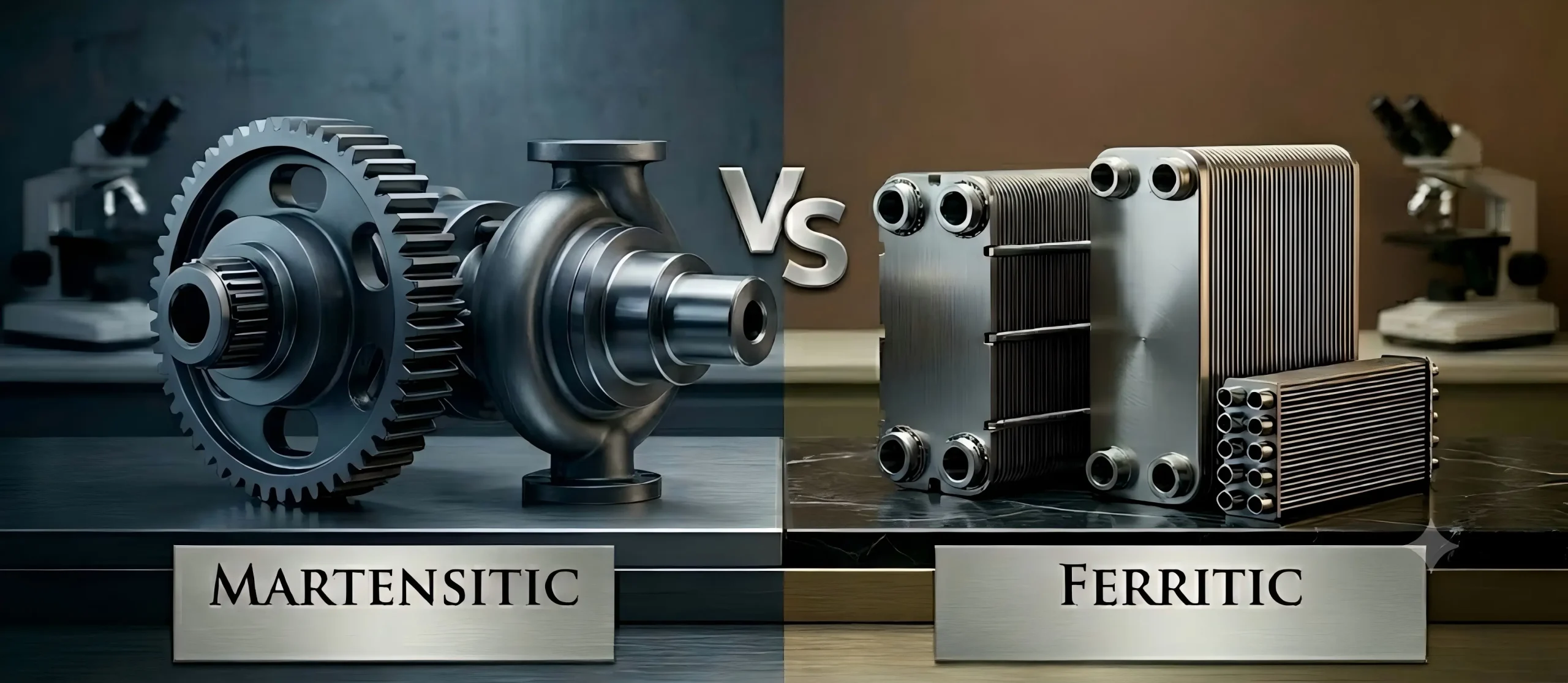
What Is Martensitic Stainless Steel?
Martensitic stainless steel is a chromium-based stainless steel designed for high strength, hardness, and wear resistance. Unlike most other stainless steel families, it can be hardened through heat treatment. This makes it a common choice for components exposed to heavy loads, friction, or repeated mechanical stress.
According to ASM International, martensitic stainless steels are iron-chromium alloys. They contain enough carbon to form martensite during quenching. This martensitic structure is what gives the steel its high hardness, strength, and wear resistance.
Most martensitic grades contain 11.5–18% chromium, along with higher carbon levels — sometimes up to 1.2%. Common grades include 410, 420, and 440C. Higher carbon content generally means higher hardness and wear resistance. Grade 440C, for example, can reach 58–60 HRC after heat treatment. This makes it one of the hardest commercially available stainless steel grades.
Martensitic stainless steels generally offer lower corrosion resistance than ferritic or austenitic grades. However, they offer excellent strength, hardness, and wear resistance. These properties make them a common choice for valves, pump shafts, turbine components, surgical instruments, and cutting tools.
What Is Ferritic Stainless Steel?
Ferritic stainless steel is a chromium-based stainless steel family known for its good corrosion resistance, formability, and cost efficiency. Most ferritic grades contain little or no nickel. Unlike martensitic steel, they cannot be significantly hardened through heat treatment. Instead, their properties come mainly from chemical composition and how they are processed.
According to ASM International, ferritic stainless steels are iron-chromium alloys with a ferritic structure at all temperatures. They typically contain 10.5–30% chromium and very low carbon — usually below 0.08%.
This low carbon content helps reduce chromium carbide formation. That leaves more chromium available to protect against corrosion. Because ferritic grades use little or no nickel, they are also less affected by nickel price swings. This often makes them more economical than other stainless families.
Common ferritic grades include 409, 430, and 446. Grade 430 is one of the most widely used — found in appliances, architectural trim, and food-service equipment. It strikes a practical balance between corrosion resistance, formability, and cost.
Ferritic stainless steels cannot match the hardness of heat-treated martensitic grades. But they offer good oxidation resistance, better dimensional stability, and good resistance to chloride-induced stress corrosion cracking. This is why they are widely used in automotive exhaust systems, heat exchangers, appliances, and decorative components.
Why Are They Different?
Martensitic and ferritic stainless steels both belong to the 400 series. But their internal structures are fundamentally different — and this is what drives their distinct properties.
Martensitic steels contain higher levels of carbon. When heated and then rapidly cooled, carbon atoms get trapped inside the structure. This forms a hard phase called martensite. Martensite is what gives these grades their high strength, hardness, and wear resistance.
Ferritic steels contain very little carbon. Their structure stays stable through heating and cooling, with no martensite formation. As a result, they cannot be hardened much through heat treatment. But their low carbon content helps with corrosion resistance, dimensional stability, and easier fabrication.
In short: carbon level and heat treatment response explain the difference. Martensitic grades reach much higher hardness. Ferritic grades are generally easier to form, weld, and manufacture.
Martensitic vs. Ferritic Stainless Steel: Key Differences
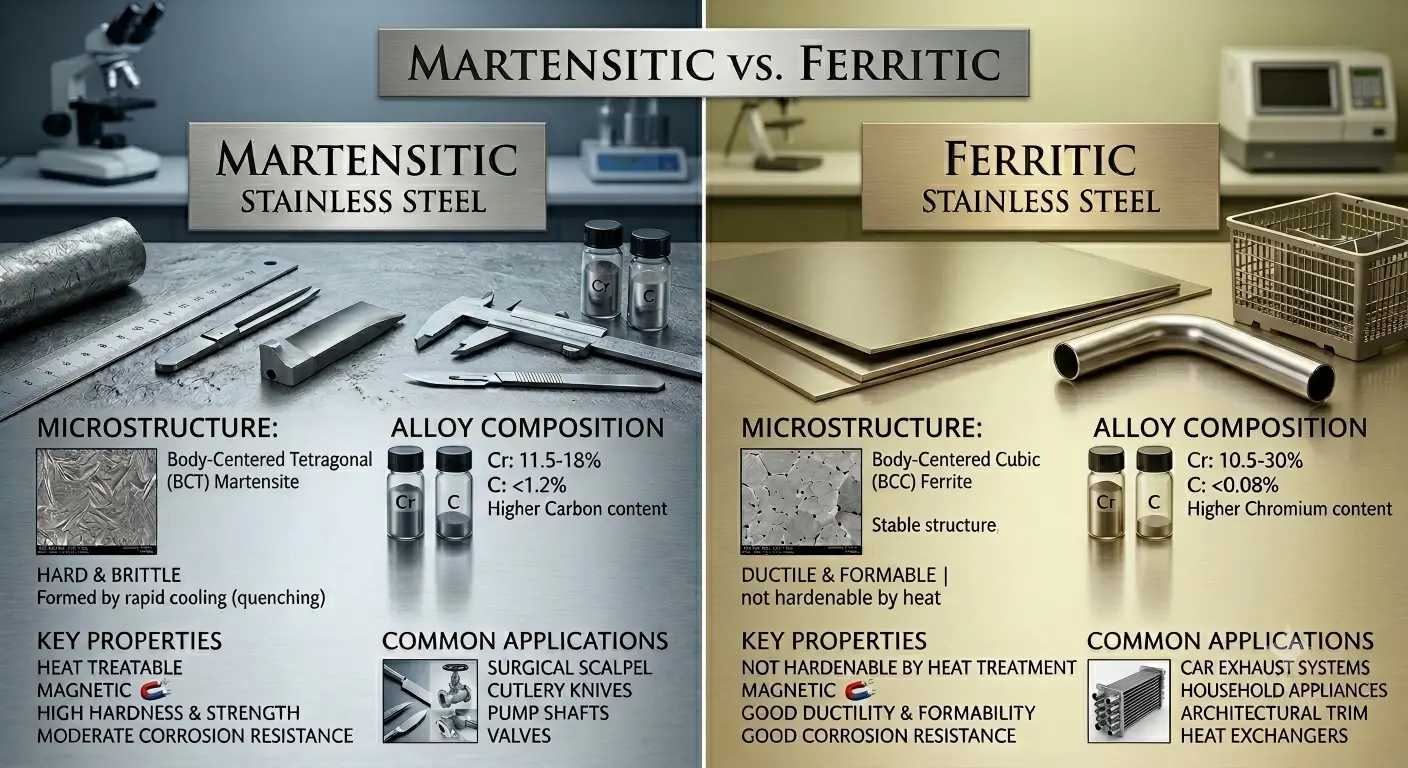
The table below summarizes the main differences between martensitic and ferritic stainless steels.
| Property | Martensitic Stainless Steel | Ferritic Stainless Steel |
| Typical Grades | 410, 420, 431, 440C | 409, 430, 446 |
| Microstructure | Martensitic (BCT after quenching) | Ferritic (BCC) |
| Chromium Content | Typically 11.5–18% | Typically 10.5–30% |
| Carbon Content | Higher (up to ~1.2%) | Very low (typically <0.08%) |
| Heat Treatable | Yes | No |
| Hardness Potential | Very high | Moderate |
| Strength | High to very high | Moderate |
| Wear Resistance | Excellent | Moderate |
| Corrosion Resistance | Moderate | Good to very good |
| Oxidation Resistance | Good | Good to excellent |
| Weldability | More challenging | Generally easier |
| Formability | Moderate to poor | Good |
| Cost | Moderate to high | Generally lower |
| Magnetic | Yes | Yes |
Both families belong to the 400 series. Both are chromium-based stainless steels. But their performance is very different.
Strength and Hardness
Martensitic stainless steel is designed for strength.
It becomes very hard after heat treatment. During quenching and tempering, its structure changes into martensite. This structure increases both hardness and strength.
Grades such as 410, 420, and 440C are widely used in wear-heavy applications. Grade 440C can reach 58–60 HRC after heat treatment. This makes it one of the hardest stainless steels in use.
Ferritic stainless steel cannot be hardened by heat treatment. Its strength depends on chemistry and cold processing. Grades like 409 and 430 provide moderate strength. But they offer better ductility and formability.
For high load or wear resistance, martensitic steel is usually preferred.
Corrosion Resistance
Ferritic stainless steel usually performs better in corrosion resistance.
Martensitic grades contain more carbon. During heat treatment, carbon can form chromium carbides. This reduces the amount of free chromium in the steel. Less free chromium means weaker corrosion protection.
Ferritic grades contain very little carbon. This keeps chromium available to protect the surface. As a result, ferritic steel performs better in many environments.
Ferritic grades also resist chloride-induced stress corrosion cracking. This makes them more stable in humid or coastal conditions.
For outdoor or corrosive environments, ferritic steel is often the safer choice.
Heat Treatment and Weldability
These two families behave very differently during processing.
Martensitic stainless steel is designed for heat treatment. This is how it gains strength and hardness. But this also makes welding more difficult.
After welding, fast cooling can create hard and brittle zones. In many cases, preheating or post-weld heat treatment is required.
Ferritic stainless steel does not harden through heat treatment. This makes it easier to process and weld in most cases.
However, thick sections still require care. Grain growth can reduce toughness if welding is not controlled.
In general, ferritic steel is easier to fabricate.
Cost and Material Availability
Ferritic stainless steel is usually more cost stable.
It contains little or no nickel. This reduces exposure to nickel price changes. It also helps keep overall material cost lower.
Martensitic grades often require heat treatment steps. This increases processing cost and production time.
Ferritic steel is often chosen when cost and corrosion resistance matter most.
Martensitic steel is chosen when performance is the priority.
Common Applications
Martensitic and ferritic stainless steels are used in very different industrial environments. The choice usually depends on whether the priority is mechanical strength or corrosion resistance and cost efficiency.
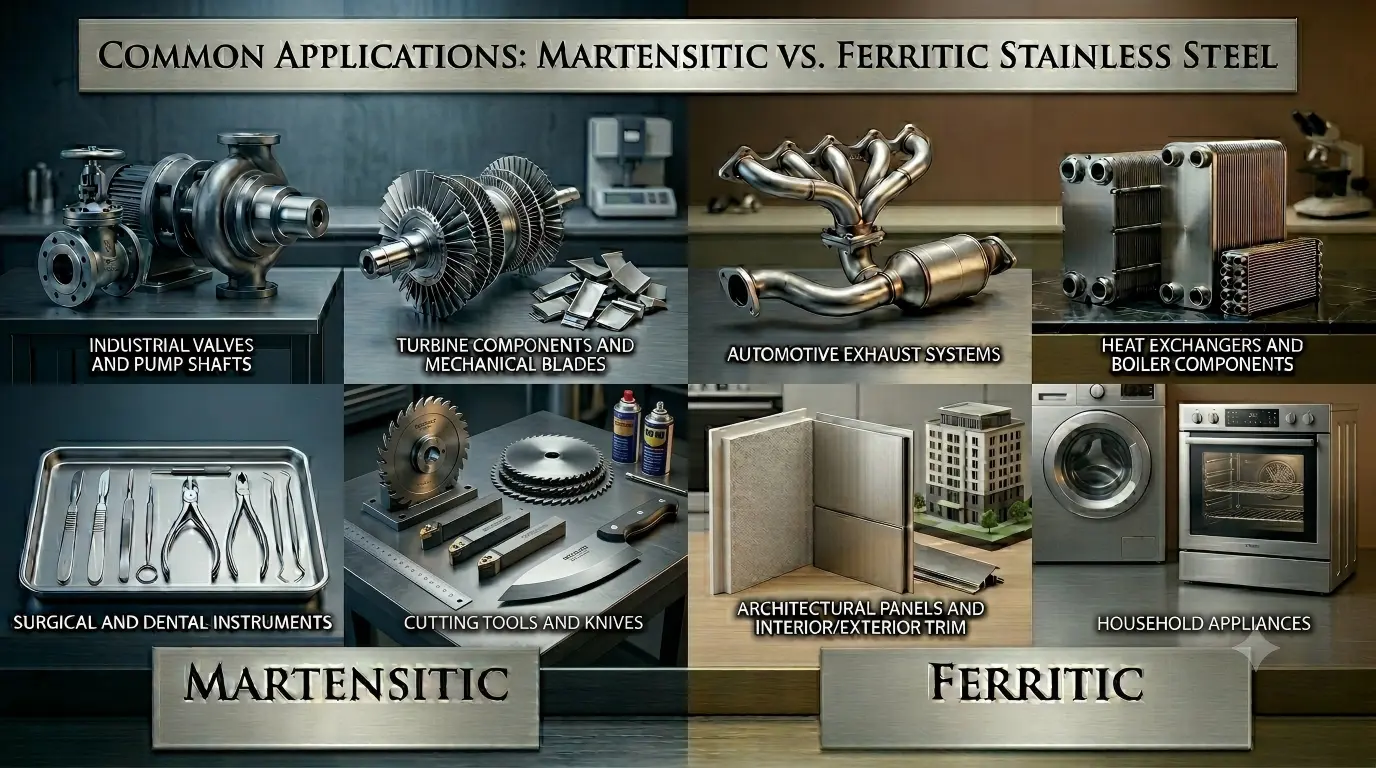
Martensitic Stainless Steel Applications
Martensitic stainless steels are used in applications where high strength, hardness, and wear resistance are critical.
Typical applications include:
- Industrial valves and pump shafts
- Turbine components and mechanical blades
- Surgical and dental instruments
- Cutting tools and knives
- High-strength fasteners and precision mechanical parts
In these applications, durability under load is more important than maximum corrosion resistance.
Ferritic Stainless Steel Applications
Ferritic stainless steels are commonly used in environments where corrosion resistance, thermal stability, and cost control are more important than extreme strength.
Typical applications include:
- Automotive exhaust systems
- Heat exchangers and boiler components
- Household appliances such as ovens and washing machines
- Architectural panels and interior/exterior trim
- Food service and light industrial equipment
These grades are widely used in large-scale production because they offer stable performance at a lower material cost.
How to Choose Between Martensitic and Ferritic Stainless Steel
The right choice depends on the service conditions of your application. In most engineering cases, the decision comes down to three factors: mechanical load, corrosion environment, and manufacturing requirements.
Choose martensitic stainless steel if:
- Your part requires high strength, hardness, or wear resistance
- It faces heavy loads, strong friction, or repeated mechanical stress — typical examples include shafts, valves, cutting tools, and turbine components
- Surface wear or deformation could lead to failure — though this comes with added heat treatment and welding requirements
Choose ferritic stainless steel if:
- Your part operates in a corrosive or outdoor environment
- It will face moisture, air exposure, or mild chemical contact — commonly used in exhaust systems, heat exchangers, and architectural components
- Manufacturing efficiency matters — ferritic steel offers easier forming, better weldability, and lower material cost than martensitic grades
When both properties are required:
Some applications need both corrosion resistance and higher mechanical strength. In these cases, neither ferritic nor martensitic stainless steel is a perfect match. Engineers often consider duplex stainless steels as an alternative, since they offer a balance of strength and corrosion resistance.
Frequently Asked Questions
Q: What is the difference between 410 and 430 stainless?
A: Grade 410 is a martensitic stainless steel that can be heat treated for higher strength and hardness. Grade 430 is a ferritic stainless steel that offers better corrosion resistance, formability, and lower cost. The better choice depends on whether strength or corrosion resistance is the priority.
Q: Is 410 stainless steel martensitic?
A: Yes. Grade 410 is one of the most widely used martensitic stainless steels. It can be heat treated to improve strength and hardness and is commonly used in valves, pump shafts, fasteners, and industrial components.
Q: Is 430 stainless steel ferritic?
A: Yes. Grade 430 is one of the most common ferritic stainless steels. It offers a practical balance of corrosion resistance, formability, and cost, making it widely used in appliances, architectural trim, and food-service equipment.
Q: Which is stronger, martensitic or ferritic stainless steel?
A: Martensitic stainless steel is generally stronger after heat treatment. Grades such as 420 and 440C can achieve much higher hardness and wear resistance than ferritic grades, making them better suited for high-load and wear-critical applications.
Q: Which has better corrosion resistance, martensitic or ferritic stainless steel?
A: Ferritic stainless steel generally offers better corrosion resistance. Its lower carbon content helps keep more chromium available for corrosion protection. Ferritic grades also provide good resistance to chloride-induced stress corrosion cracking in many environments.
Q: Which is easier to weld, martensitic or ferritic stainless steel?
A: Ferritic stainless steel is usually easier to weld. Martensitic grades are more sensitive to rapid cooling and may require preheating or post-weld heat treatment to reduce the risk of cracking and maintain performance.
Q: Can ferritic stainless steel be hardened through heat treatment?
A: No. Ferritic stainless steel cannot be significantly hardened through heat treatment. Its mechanical properties are primarily determined by its chemical composition and manufacturing process rather than quenching and tempering.
Conclusion
Martensitic and ferritic stainless steels are designed for different engineering priorities.
Martensitic grades provide high strength, hardness, and wear resistance, making them suitable for components exposed to heavy loads and mechanical stress. Ferritic grades offer better corrosion resistance, easier fabrication, and lower material costs, making them a practical choice for many industrial and commercial applications.
The best material depends on your performance requirements, service environment, manufacturing process, and budget. Understanding these differences can help you select a stainless steel grade that delivers the right balance of performance, reliability, and cost.
If you need support with stainless steel selection or sourcing, contact the SUMEC Metal team for technical guidance and material solutions.
Learn More About Our Products?
Contact Now