

How Is Steel Made: From Iron Ore to Finished Product Explained
Steel is made through an eight-step process that converts iron ore into finished products. A blast furnace first reduces iron ore into liquid pig iron at 2,000°C using coke and limestone. A basic oxygen furnace (BOF) or electric arc furnace (EAF) then refines it into steel. Continuous casting, hot rolling, cold rolling, and coating complete the cycle.
This guide is compiled by SUMEC Metal, a Shanghai-listed state-owned steel supplier (SHA: 600710) operating since 1978 across 120+ countries. Readers will learn the six raw materials, eight production stages, five finished product families, and the ASTM and ISO standards behind each.
What Is Steel?
Steel is an alloy made of iron and carbon. The carbon content ranges from 0.02% to 2.1% by weight. Materials with more than 2.1% carbon are classified as cast iron, not steel.
The amount of carbon in steel determines its properties. Low carbon content (below 0.3%) produces softer, more ductile steel that’s easier to weld and form. High carbon content (0.6% to 2.1%) creates harder, stronger steel that’s less flexible. Most structural steel contains 0.15% to 0.3% carbon.
Common alloying elements added to steel include:
- Manganese (improves strength and hardness)
- Chromium (increases corrosion resistance)
- Nickel (enhances toughness)
- Vanadium (adds strength at high temperatures)
- Silicon (removes oxygen during production)
Pure iron alone lacks strength. Adding small amounts of carbon transforms weak iron into strong, versatile steel. Manufacturers also remove impurities like sulfur, phosphorus, and excess oxygen during production. These unwanted elements make steel brittle or weak.
What Are the Raw Materials of Steelmaking?
Steel production requires six main raw materials that serve different purposes in the manufacturing process:
- Iron Ore: It contains the iron needed to make steel. The ore is mined from the earth and comes in forms like hematite and magnetite.
- Metallurgical Coal & Coke: Coke serves as fuel in blast furnaces and provides carbon that helps remove oxygen from iron ore. This process turns iron ore into usable iron.
- Limestone: It acts as a cleaning agent during steelmaking. It combines with impurities in the iron ore to form slag, which floats on top of molten metal and gets removed.
- Recycled steel scrap: It can replace some or all of the iron ore in certain production methods.
- Direct Reduced Iron (DRI): It is another iron source made by removing oxygen from iron ore using natural gas instead of coke.
- Alloying Elements: Small amounts of other metals get added to create different steel types. These elements change the steel’s properties like strength, hardness, and resistance to rust.
What Are the Steps From Iron Ore to Finished Product?
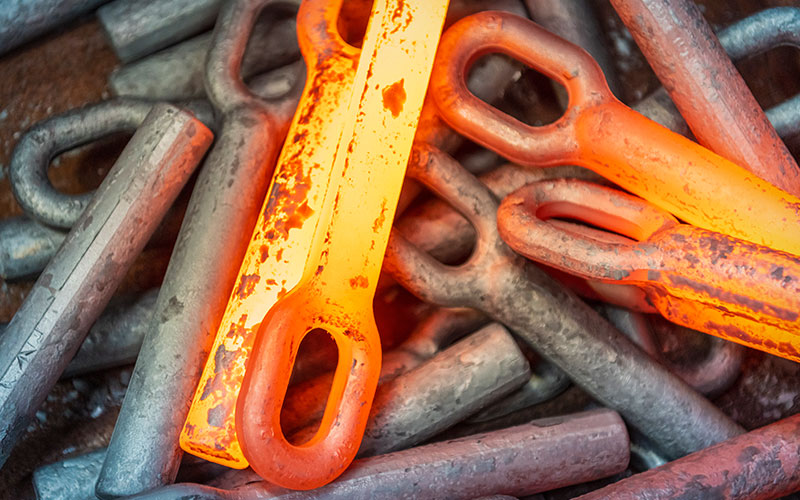
Steel production moves through eight distinct steps, starting with raw iron ore extracted from the ground and ending with coated, finished products ready for use. Each step transforms the material through heat, chemistry, and mechanical force.
Step 1 —Iron Ore Preparation
Iron ore arrives at steel mills as rocks containing iron oxides mixed with unwanted materials. The ore goes through crushing and screening to break it into uniform sizes. Mills blend different ore types to achieve consistent iron content, typically 60-70% iron by weight.
The prepared ore gets combined with coke (processed coal) and limestone. Coke provides the heat and carbon needed for chemical reactions. Limestone acts as a flux, binding with impurities to form slag that separates from the metal.
This mixture enters a sintering process that heats the materials below their melting point. The particles fuse together into porous chunks called sinter. Sinter has better airflow properties than raw ore, making it more efficient in the next stage.
Step 2 — Ironmaking: From Ore to Pig Iron
The blast furnace converts prepared iron ore into liquid pig iron. This furnace stands up to 30 meters tall and operates continuously at temperatures reaching 2,000°C.
Workers load sinter, coke, and limestone through the top of the furnace. Hot air blasts through openings called tuyeres near the bottom. The coke burns in this oxygen-rich environment, generating intense heat and carbon monoxide gas.
Carbon monoxide rises through the descending materials, stripping oxygen from iron oxide in a process called reduction. The chemical formula changes from Fe₂O₃ to metallic iron (Fe). The metallic iron melts and collects at the furnace bottom.
Limestone combines with sand and other impurities to form liquid slag. Slag floats on top of the denser iron due to its lower density. Workers tap both materials separately through different openings. The resulting pig iron contains 3-4% carbon, plus silicon, manganese, and other elements.
Step 3 — Primary Steelmaking: Iron Becomes Steel
Primary steelmaking reduces the carbon content in pig iron from 3-4% down to 0.1-2%. Most modern facilities use the Basic Oxygen Furnace (BOF) method.
The BOF vessel tilts to receive molten pig iron and scrap steel. A water-cooled lance lowers into the vessel and blows pure oxygen onto the metal at supersonic speeds. This oxygen reacts with carbon in the iron, forming carbon monoxide and carbon dioxide gases that escape.
The violent reaction raises temperatures to 1,700°C without additional fuel. Silicon, manganese, and phosphorus also oxidize and transfer into slag. The process takes 15-20 minutes per batch. Workers tilt the vessel to pour the molten steel into a ladle.
Electric Arc Furnaces (EAF) offer an alternative route. These furnaces melt 100% scrap steel using electricity conducted through graphite electrodes. EAF steel accounts for 30% of global production.
Step 4 — Secondary Steelmaking (Ladle Metallurgy)
Secondary steelmaking fine-tunes the steel’s chemistry and removes impurities that primary steelmaking leaves behind. The molten steel sits in a large ladle that functions as a refining vessel.
Workers add precise amounts of alloy elements to achieve target specifications. Common additions include:
- Chromium – increases corrosion resistance
- Nickel – improves toughness
- Manganese – enhances strength and hardness
- Molybdenum – adds high-temperature strength
Argon gas bubbles through the steel from the bottom, stirring the mixture and helping dissolved gases escape. Slag on the steel’s surface absorbs sulfur and oxygen. Some operations use vacuum degassing to remove hydrogen, which causes brittleness.
Temperature adjustments occur through controlled heating or cooling. This stage typically lasts 30-60 minutes. The steel exits with precise chemistry and cleanliness levels.
Step 5 — Continuous Casting
Continuous casting transforms molten steel into solid shapes without interruption. The ladle pours steel into a water-cooled copper mold at controlled rates.
The mold gives the steel its initial shape: slabs (200-300mm thick), blooms (square cross-sections), or billets (smaller squares or rounds). Water sprays cool the steel’s outer surface, forming a solid shell while the interior remains liquid.
Rollers pull the partially solidified steel downward through a curved path. More water sprays and cooling zones gradually solidify the entire cross-section. The steel travels 10-20 meters before complete solidification.
Oxygen torches cut the continuous strand into specific lengths. A single strand can produce 100-200 tons per hour. The cast pieces, still at 700-900°C, move directly to rolling mills or go to storage yards to cool.
Step 6 — Hot Rolling
Hot rolling shapes cast steel into thinner, longer products while the metal remains above 900°C. Reheating furnaces bring cooled slabs back to 1,200°C for easier deformation.
The steel passes through a series of rolling mill stands. Each stand contains two or more rollers that squeeze and stretch the material. A slab might go through 6-8 stands, reducing from 250mm to 2-5mm thickness.
Hot rolling produces:
- Steel plate (6-200mm thick)
- Hot-rolled coil (1.5-12mm thick)
- Structural shapes (I-beams, channels)
- Rail and bar products
The process generates an oxide layer (mill scale) on the surface. High-pressure water jets remove most of this scale. The steel exits at temperatures around 600-700°C and coils onto large reels for cooling.
Step 7 — Cold Rolling
Cold rolling occurs at room temperature and improves surface finish and dimensional accuracy. Hot-rolled steel first passes through pickling tanks that remove surface scale using acid solutions.
The cleaned steel enters cold rolling mills where rollers apply pressure at room temperature. This process reduces thickness by 50-90% and work-hardens the steel, increasing its strength.
Cold rolling delivers:
- Smooth, clean surfaces
- Tight thickness tolerances (±0.05mm or better)
- Improved mechanical properties
- Better edge quality
Annealing may follow cold rolling to restore ductility. The steel heats to 600-700°C in a controlled atmosphere, then cools slowly. This removes internal stresses and makes the steel easier to form.
Step 8 — Coating, Plating & Finishing
Surface treatments protect steel from corrosion and prepare it for specific uses. The choice depends on the application and environment.
Galvanizing dips steel in molten zinc at 450°C. A zinc layer of 20-80 microns forms and provides corrosion protection for 20-50 years outdoors.
Electroplating deposits thin metal layers (zinc, nickel, chromium) using electrical current. This creates decorative finishes or adds specific properties.
Painting and powder coating apply organic layers that prevent rust and add color. Primers bond directly to steel, followed by topcoats for UV and weather resistance.
Cutting and forming shape the steel into final products. Laser cutting, stamping, bending, and welding create parts ranging from car bodies to appliances.
Quality inspection verifies dimensions, surface quality, and mechanical properties before shipping.
What Are the Finished Steel Product Families?
Manufacturers classify finished steel products into five distinct metallurgical families based entirely on their exact chemical compositions. These specific families serve distinct downstream industrial applications ranging from basic structural construction to extreme aerospace engineering.
Manufacturers distribute the final output across five main categories.
- Carbon steel serves structural construction and general fabrication applications.
- Special alloy steel supports automotive manufacturing, heavy machinery, and industrial molds.
- Stainless steel provides corrosion resistance for food processing, medical equipment, architectural structures, and chemical plants.
- Tool steel offers extreme physical hardness for stamping dies, cutting tools, and plastic injection molds.
- Superalloys withstand extreme thermal environments in aerospace engines, oil and gas extraction, and power generation facilities.
What Standards and Certifications Ensure Final Steel Quality?
Global regulatory bodies require certified mill test certificates to guarantee exact chemical compositions and physical yield strengths. Facilities must execute strict mechanical testing and dimensional inspections before shipping any final product.
Technicians perform non-destructive testing to verify internal structural integrity. Ultrasonic sensors detect internal voids. Magnetic particle inspections reveal surface micro-cracks. Independent organizations like ASTM International and ISO publish these exact testing protocols globally.
FAQs
What is green steel?
Green steel is steel produced using hydrogen instead of coal, which eliminates carbon dioxide emissions during manufacturing. Traditional steelmaking releases about 1.85 tons of CO₂ per ton of steel through coal combustion. Hydrogen-based methods use renewable electricity to split water into hydrogen and oxygen, then use that hydrogen to remove oxygen from iron ore.
Is steel 100% recyclable?
Steel is 100% recyclable without any loss in quality or strength. A steel product can be melted down and reformed unlimited times while maintaining its original properties. About 630 million tons of steel get recycled globally each year, making it the most recycled material on Earth.
Why is it called pig iron?
Pig iron gets its name from the traditional casting method used in early ironmaking. Molten iron from blast furnaces flowed into sand molds arranged in rows branching off a central channel. The layout looked like piglets nursing from a sow, so workers called the solidified iron pieces “pigs.”
How many tons of iron ore make one ton of steel?
Producing one ton of steel requires about 1.6 tons of iron ore on average. The exact amount varies based on ore quality and iron content. Higher-grade ores with 65-70% iron content need less material than lower-grade ores with 40-50% iron content.
Learn More About Our Products?
Contact Now