

What is Steel Hardenability? How It Impacts Heat Treatment & Part Performance
Introduction
Have you ever wondered why two steel parts with the same surface hardness can perform so differently in service? One may fail unexpectedly, while the other lasts much longer. The answer often comes down to one property: hardenability.
Hardenability determines how deeply steel can harden during heat treatment. It is a critical factor when selecting materials for gears, shafts, valves, and other load-bearing components.
In this guide, you will learn what hardenability is, what factors affect it, how it is measured, and how it affects both heat treatment results and long-term part performance.
What Is Steel Hardenability?
According to ASM International, a leading authority in materials engineering, steel hardenability is the ability of steel to harden to a certain depth during quenching. It describes how far the hardening effect can reach inside a part — from the surface toward the core.
Hardenability vs. Hardness: What Is the Difference?
Hardenability and hardness sound similar — but in engineering, they mean very different things.
- Hardness measures a material’s resistance to indentation, wear, or deformation. It mainly describes how hard the steel is at the surface.
- Hardenability measures how deeply the hardening effect develops inside a part during heat treatment. It describes the depth of hardening rather than the hardness level itself.
A steel can be very hard on the surface but still have low hardenability. In this case, hardness decreases quickly below the surface.
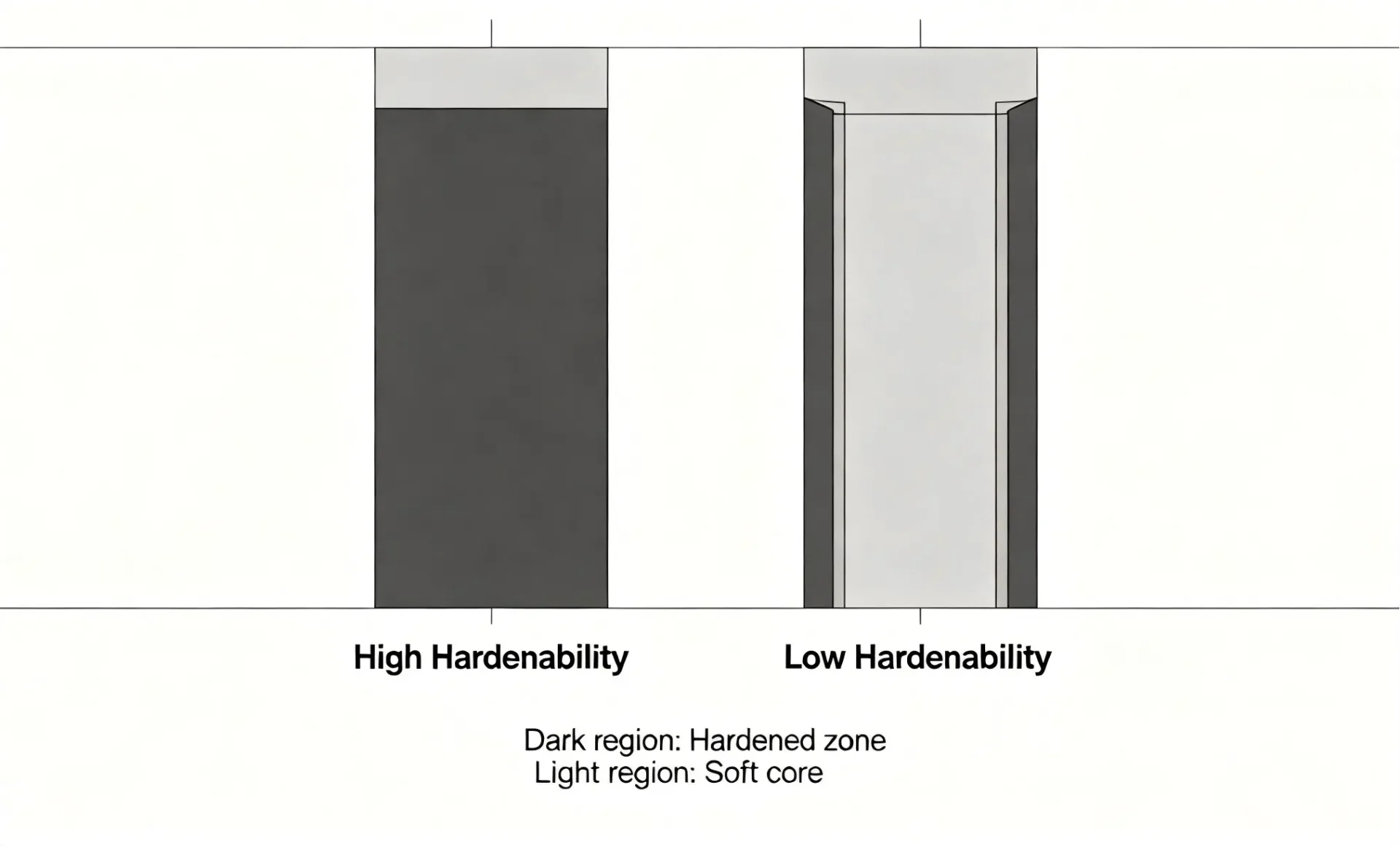
Same surface hardness — very different core strength
Think of baking bread. Two loaves may have the same hard crust on the outside. However, one is fully baked through the center, while the other remains soft and doughy inside. Hardness describes the crust, while hardenability describes how deeply the baking effect reaches.
How Does Hardenability Work?
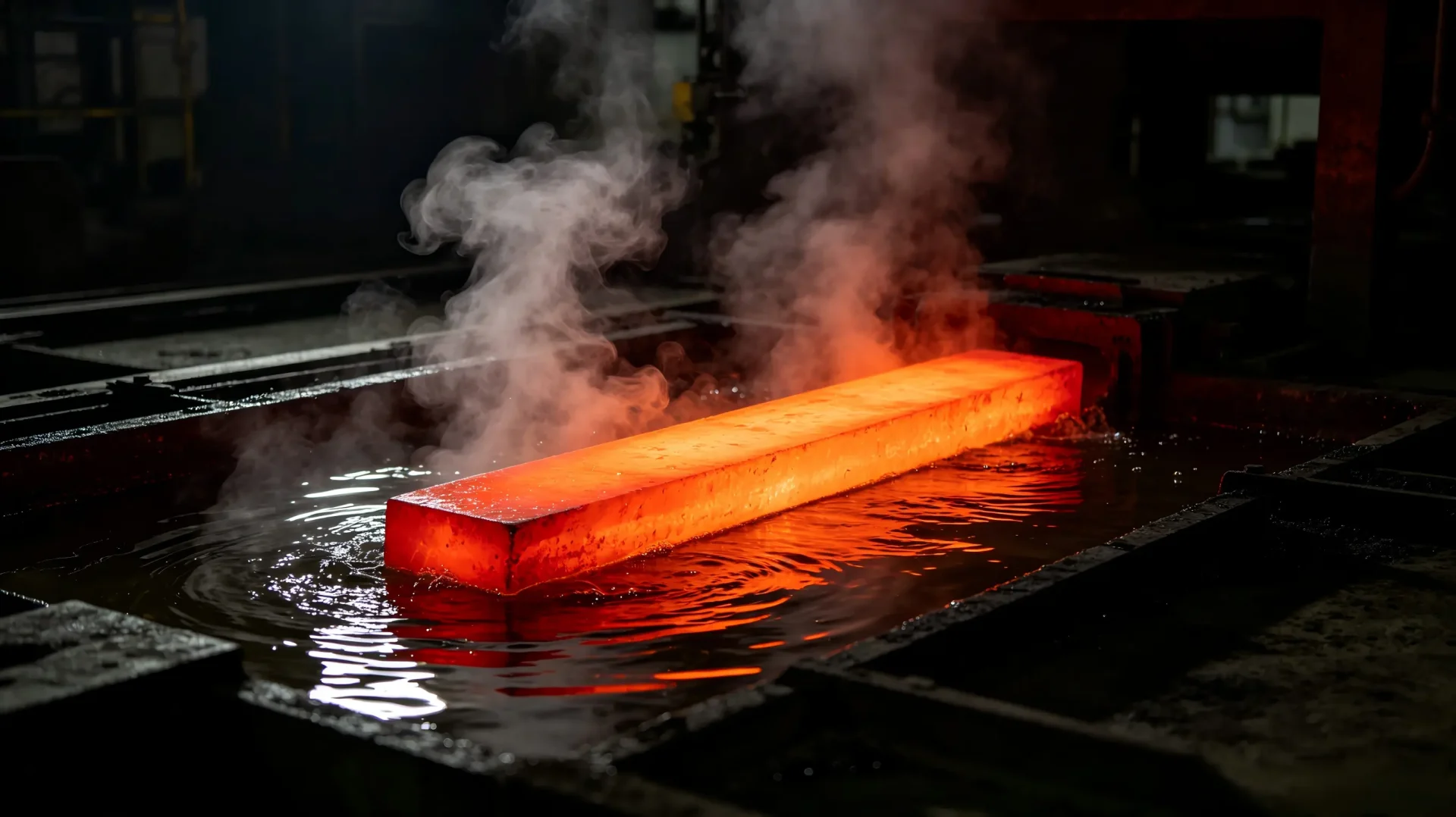
During heat treatment, steel is heated to a high temperature and then rapidly cooled in water, oil, or air — a process called quenching. When a steel part is quenched, the outer surface cools much faster than the core.
This difference in cooling speed is exactly why hardenability matters.
For steel to harden, its internal structure must transform during cooling into a hard phase called martensite. Martensite is what gives hardened steel its strength and wear resistance.
In steels with high hardenability, this transformation happens even when the core cools slowly. Hardness develops deep into the part — not just at the surface. In steels with low hardenability, only the outer layers cool fast enough to harden. The core remains soft.
This is why hardenability determines whether a part becomes fully hardened or only surface hardened.
What Factors Affect Steel Hardenability?
Several factors influence how deeply steel can harden during quenching. The most important are alloying elements, carbon content, and austenite grain size.
Alloying Elements
Alloying elements have the strongest effect on hardenability. Elements such as chromium (Cr), molybdenum (Mo), manganese (Mn), and nickel (Ni) slow down the transformation that occurs during cooling. This gives the core more time to form martensite — even when it cools more slowly than the surface.
Think of these elements as a delay mechanism. They do not make the steel harder on their own. Instead, they extend the window during which martensite can form, allowing hardness to develop deeper into the part. This is why alloy steels generally have much higher hardenability than plain carbon steels.
Carbon Content
Carbon controls the maximum hardness a steel can achieve. It also plays a supporting role in hardenability — higher carbon content makes it easier for martensite to form throughout the cross-section.
However, carbon alone is not enough to ensure deep hardening. Without the right alloying elements, even high-carbon steels may only harden near the surface.
Austenite Grain Size
When steel is heated during heat treatment, its internal structure reorganizes into grains. Larger grains increase hardenability because they reduce the number of grain boundaries. Grain boundaries are where softer microstructures tend to form first during cooling.
However, grain size must be carefully controlled. Grains that grow too large can make the finished part brittle and prone to cracking under load.
How Is Steel Hardenability Measured?
Hardenability is not measured with a single number. Instead, it is evaluated by observing how hardness changes from the surface toward the core after a controlled heat treatment process.
The most widely used method is the Jominy end-quench test, standardized under ASTM A255 and ISO 642.
The test follows three steps:
- Heating: A standard steel bar is heated until its internal structure becomes fully uniform.
- Controlled Quenching: The hot bar is transferred to a fixture where a controlled jet of water sprays only the bottom end, cooling that specific tip almost instantly. This creates a cooling gradient along the bar.
- Hardness Mapping: Once fully cooled, technicians grind a narrow flat surface along its side and measure the hardness at precise intervals starting directly from the water-quenched tip.
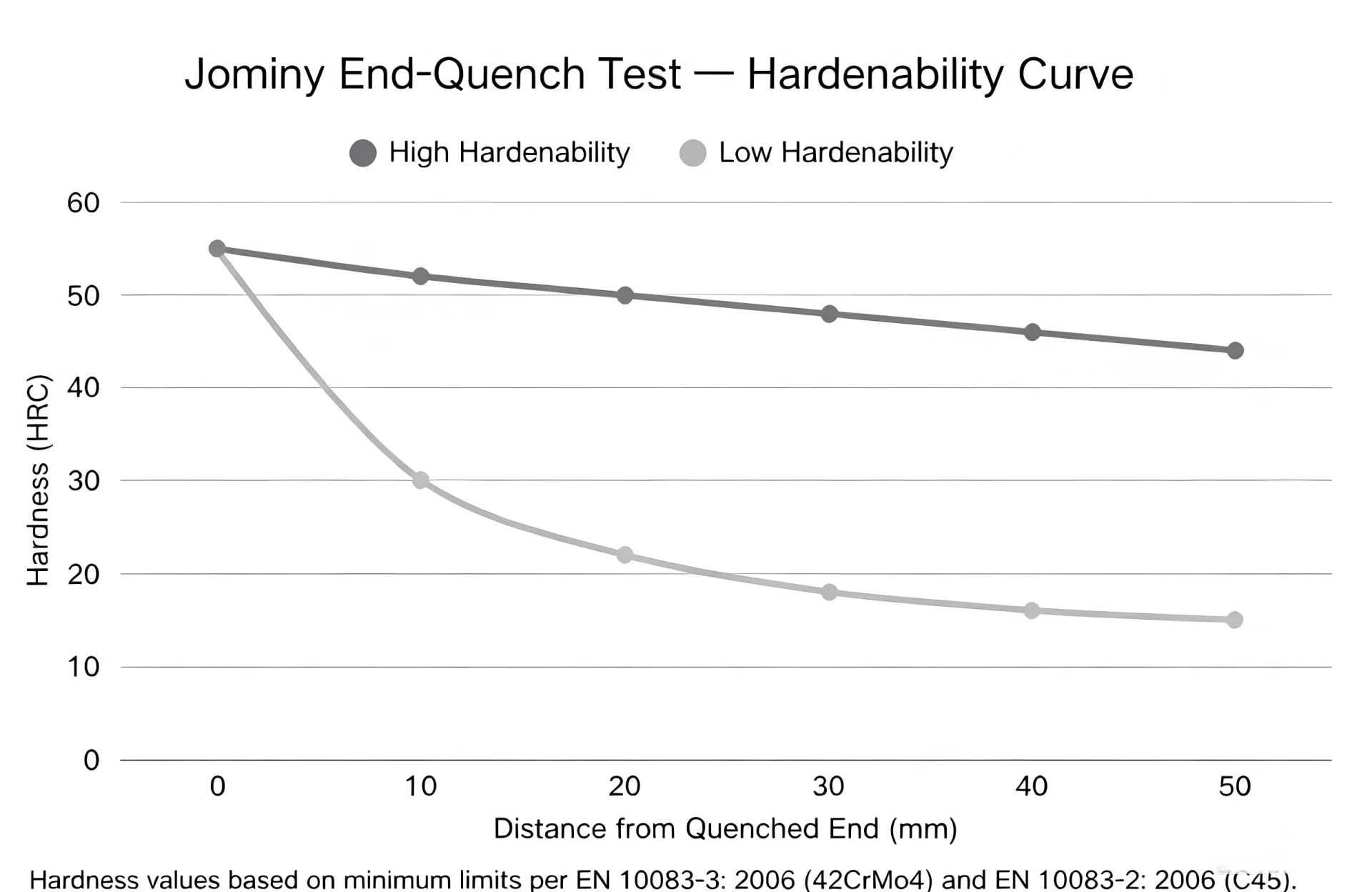
These values are plotted on a graph to produce a hardenability curve, which shows how hardness changes with distance from the quenched end for comparing steel grades:
- In steels with high hardenability, hardness remains high even far from the quenched end. This means the hardening effect reaches deep into a real part.
- In steels with low hardenability, hardness drops sharply within the first few millimeters, indicating that only the surface will harden in practice.
The hardenability curve provides a standardized reference for engineers and manufacturers worldwide. It helps compare steel grades and verify material specifications before production begins.
How Steel Hardenability Impacts Heat Treatment
Hardenability directly influences how a steel part must be processed during heat treatment, especially during quenching.
When working with low-hardenability steel, the cooling process must be very fast. Engineers often rely on water quenching to achieve the required hardness. This works well for thin parts, but creates serious challenges for thick or complex shapes. The rapid temperature change creates high internal stress, increasing the risk of distortion or cracking.
High-hardenability steel reduces these challenges by allowing slower, milder cooling methods.
Milder Cooling Media
High-hardenability steels delay the transformation to softer microstructures. This means engineers can use milder quenching media — such as oil, polymer solutions, or forced air — instead of water. These media cool the part more gently, reducing thermal shock while still achieving full hardening.
Reduced Distortion
Slower cooling lowers internal stress, helping the part maintain its shape and dimensions throughout the process. This reduces the need for post-processing correction.
Lower Risk of Cracking
With lower internal stress, the risk of quench cracking is significantly reduced. This improves yield rates and reduces material waste in production.
High-hardenability steels also offer greater process tolerance. Small variations in furnace temperature or cooling conditions are less likely to affect final hardness. This leads to more consistent results across production batches.
How Steel Hardenability Affects Part Performance
Hardenability does not just affect how a part is made. It also shapes how that part holds up throughout its working life. For engineers, manufacturers, and buyers, its impact is most visible in three key areas: load-bearing capacity, fatigue resistance, and long-term reliability.
Load-Bearing Capacity
Steel parts are often built to carry heavy loads. To do this safely, the part needs strength all the way through — not just at the surface.
- High-hardenability steels develop a uniform hardened structure throughout the cross-section, allowing the part to handle heavy forces more evenly.
- Low-hardenability steels, on the other hand, may have a softer interior. Under high stress, that soft core can become a weak point and eventually lead to deformation or failure.
Fatigue Resistance
Most parts do not fail all at once. They wear down gradually under repeated loading — a process known as fatigue.
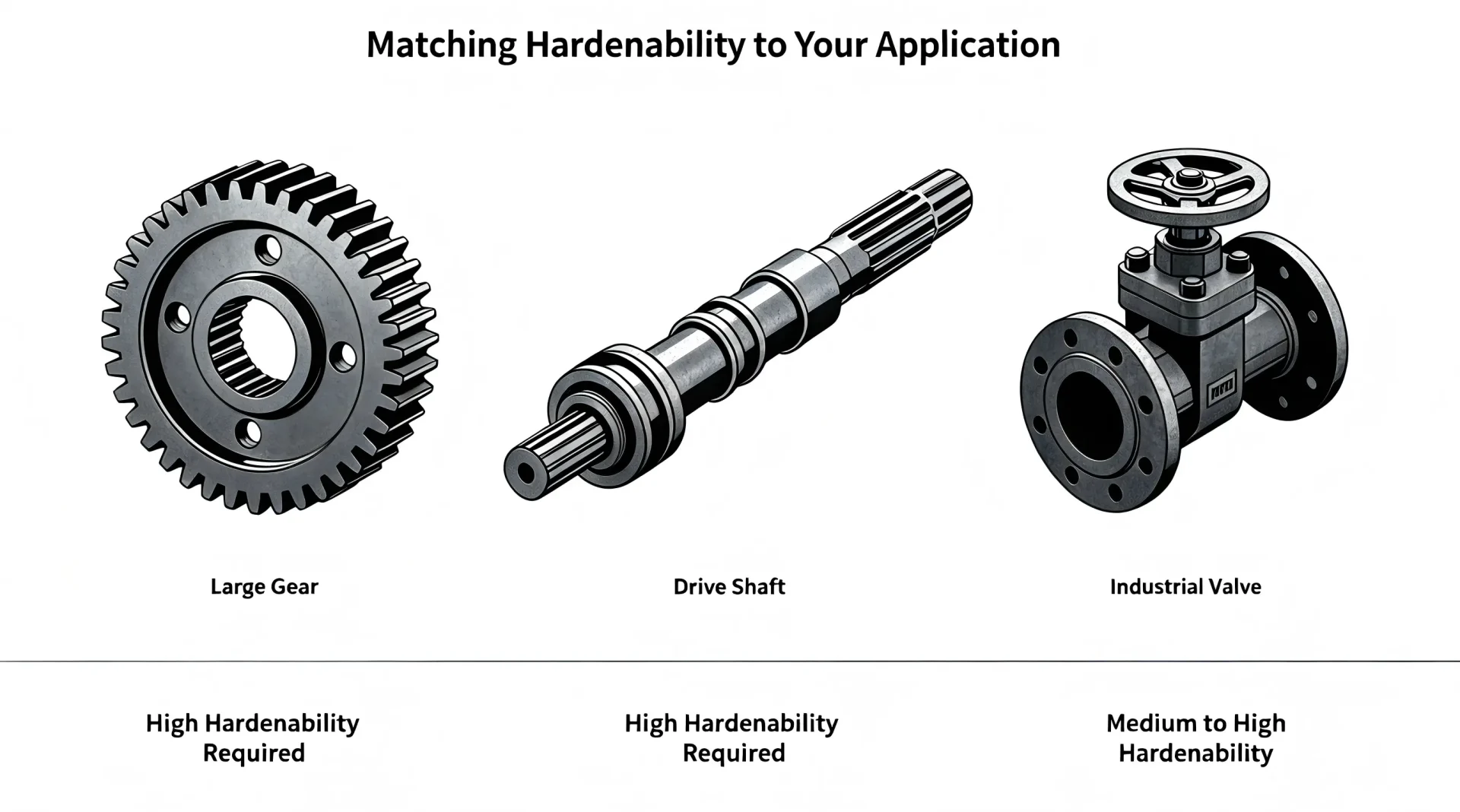
A deeper, more uniform hardened structure means fewer weak zones inside the metal where cracks can start. This gives the part better resistance to fatigue over time. It matters most for components such as gears, shafts, and axles that experience constant stress cycles in service.
Service Life and Reliability
When the internal structure of a part is consistent, its performance becomes more predictable. Parts with the right hardenability maintain their strength and wear resistance longer, even under demanding operating conditions.
Parts with insufficient hardenability may seem fine at first. Over time, however, they are more likely to wear unevenly, deform, or fail earlier than expected.
For critical components, this is not just a technical decision. The right hardenability directly affects how long a part lasts — and how reliably it performs.、
Choosing the Right Hardenability for Your Application
There is no single “best” level of hardenability. The right choice depends on part size, service conditions, and the heat treatment process. When selecting steel for your next production run, focus on these three factors.
Part Size
Thick or large components cool more slowly at the core during quenching. They require steels with higher hardenability — typically alloy grades containing chromium, molybdenum, or manganese — to achieve uniform hardness throughout. Smaller components can often meet requirements with lower-hardenability steels at a lower cost.
Service Conditions
Components under heavy loads, repeated stress, or severe wear — such as gears, shafts, and axles — need higher hardenability. This ensures they maintain strength and fatigue resistance throughout the full cross-section. For less demanding applications, lower-hardenability steels may provide sufficient performance at a lower material cost.
Heat Treatment Process
Higher-hardenability steels can often be quenched using milder media such as oil or forced air, reducing the risk of distortion and cracking. Lower-hardenability steels typically require faster, more aggressive cooling, which increases processing complexity and dimensional risk.
Selecting a steel with the appropriate hardenability helps balance part performance, process reliability, and production cost.
Frequently Asked Questions
Q: Is hardenability the same as hardness?
A: No. Hardness measures a material’s resistance to wear or deformation at the surface. Hardenability measures how deeply that hardening effect can develop inside a part during heat treatment. A steel can be very hard on the surface but still have low hardenability — meaning its strength drops off quickly just below the surface.
Q: Why does alloy steel generally have higher hardenability than plain carbon steel?
A: Plain carbon steel does not contain the alloying elements needed to slow down structural changes during cooling. Without them, the core cools too slowly to form martensite and stays soft. Alloy steels contain elements such as chromium, molybdenum, and manganese that act as a delay mechanism — giving the core enough time to fully harden, even in thick sections.
Q: Is higher hardenability always better for industrial parts?
A: Not necessarily. For large, thick, or heavily loaded components such as drive shafts and gears, high hardenability is essential. For smaller parts or components that only face surface wear — such as conveyor rollers — lower-hardenability carbon steels provide good wear resistance and a tough core at a lower material cost.
Q: How do engineers and manufacturers use Jominy curve data in production?
A: They use it to predict whether a steel grade will achieve the required core hardness for a specific section thickness. By checking hardness values at precise distances from the quenched end, they can also determine whether milder quenching media — such as oil or forced air — can be used safely, reducing the risk of distortion and cracking.
Selecting the right steel starts with understanding hardenability. If you need help choosing the right grade for your application, contact the SUMEC Metal team for support in material selection and application guidance.
Learn More About Our Products?
Contact Now