
How To Calculate Steel Coil Weight : Formula And Chart
Steel coil weight can be accurately determined using formulas based on coil dimensions and material density. Understanding how to calculate coil weight—whether through flat-length methods, annular volume formulas, weight-per-meter calculations, or using standardized charts and online calculators—helps ensure safe handling, cost control, efficient planning, and accurate material estimation across industries. This article explains what a steel coil is, the essential parameters required for precise weight calculation, the main formulas used, and practical tools such as calculators, charts, and PIW values.
What Is A Steel Coil?
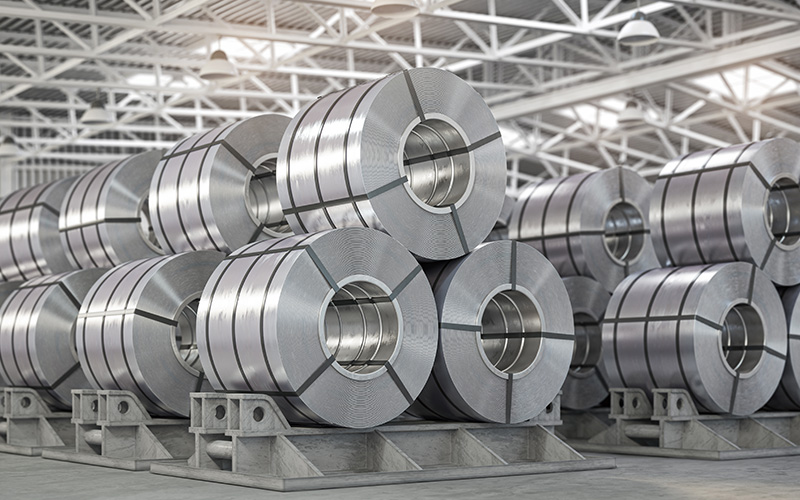
A steel coil is a long, continuous sheet of steel wound into a roll after hot or cold rolling. Coils are widely used because they are easy to transport, store, and process into smaller sheets or strips for construction, automotive, appliances, and machinery.
Knowing a coil’s size and dimensions allows manufacturers and engineers to calculate its volume and weight before processing or shipping.
What Are The Essential Parameters of A Steel Coil?
Accurate coil weight calculations depend on knowing the outer diameter (OD), inner diameter (ID), width, thickness, and material density. Each measurement affects the coil’s total volume and weight, making precise data collection critical for production, transport, and inventory planning.
Outer and Inner Diameter
The outer diameter (OD) and inner diameter (ID) describe the coil’s outside size and core opening. They are used to calculate the cross-sectional area and volume. Both values are taken with consistent units to ensure accurate results.
Coil Width and Thickness
Width is the distance across the strip. Thickness is the depth of the steel sheet. These two measurements affect the coil’s volume and final weight. Accurate measurement reduces calculation errors.
Material Density
Density varies by steel type. Each material has its own fixed density value, which is required to convert volume into weight. Using the correct density keeps the weight calculation consistent.
How to Calculate Steel Coil Weight?
Steel coil weight depends on the coil’s dimensions and material density. There are three common calculation methods: flat-length method, annular volume method, and weight-per-meter method.
Flat-Length Method
This method calculates weight based on the uncoiled sheet length. It works well when the coil’s thickness and width are known. The key formula is:
Weight = Width × Thickness × Length × Density
Density for carbon steel is usually 0.284 lb/in³ (7.85 g/cm³).
How to use flat-length method to calculate the steel coil wight:
- Measure the coil’s width and thickness in consistent units.
- Determine the flat length of the uncoiled sheet.
- Multiply these values by the material density.
Example:
A 48-inch-wide, 0.1-inch-thick steel coil with a flat length of 1,000 inches weighs:
48 × 0.1 × 1,000 × 0.284 = 1,363 lb.
This approach is simple but requires knowing the full uncoiled length, which may not always be available.
Annular Volume Method
The annular volume method uses the coil’s outside diameter (OD), inside diameter (ID), and width to find weight. It calculates the material volume as the area of the circular ring multiplied by the width.
Formula:
Volume = (π / 4) × (OD² − ID²) × Width
Then,
Weight = Volume × Density
For example, if OD = 40 in, ID = 20 in, Width = 48 in, and Density = 0.284 lb/in³:
Volume = (3.1416 / 4) × (40² − 20²) × 48 = 1,130,973 in³
Weight = 1,130,973 × 0.284 = 321,200 lb.
This method is widely used because it needs only coil diameters and width, which are easy to measure.
Weight per Meter
This method expresses coil weight as weight per unit length, often used for continuous production lines. It helps estimate coil weight quickly when only the thickness and width are known.
Formula:
Weight per Meter = Width × Thickness × Density × 1,000
The factor 1,000 converts cubic meters to millimeters when using metric units.
Once the weight per meter is known, multiply it by the coil’s total length to get the total weight.
Example:
For a 1,200 mm-wide, 2 mm-thick steel coil with density 7,850 kg/m³:
Weight per Meter = 1.2 × 0.002 × 7,850 × 1,000 = 18.84 kg/m.
This method is efficient for estimating coil weights during production or shipping.
Steel Coil Weight Charts and Calculators
Accurate coil weight data helps manufacturers plan transport, estimate material costs, and ensure safe handling. Tools like online calculators and reference charts simplify these calculations by using standard formulas and material properties.
Using Online Steel Coil Weight Calculators
A steel coil weight calculator quickly determines coil weight from a few basic inputs. Users typically enter the outside diameter (OD), inside diameter (ID), width, and thickness of the coil. Some calculators also allow selection of material type to apply the correct density value.
These tools use the same core formula applied in manual calculations but eliminate the risk of arithmetic errors. Many calculators, such as those offered by Worthington Steel or MachineMFG, support stainless, carbon, and galvanized steel.
Online calculators are especially useful for estimating weights during quoting or logistics planning. They can also output related data such as coil length or specific weight per width, helping users size coils for production or transport.
Reference Steel Coil Weight Charts
Steel coil weight charts provide quick lookup values without entering data into a calculator. They list approximate weights for common coil sizes and thicknesses, assuming a standard steel density of about 7.85 g/cm³.
Charts often organize data by width and thickness in one axis and diameter in another. For example:
| Espesor | Outer Diameter | Approx Weight (kg) |
| 1.0 mm | 1000 mm | 4574.31 |
| 1.0 mm | 1200 mm | 7287.08 |
| 1.0 mm | 1400 mm | 10493.07 |
| 2.0 mm | 1000 mm | 4574.31 |
| 2.0 mm | 1200 mm | 7287.08 |
| 2.0 mm | 1400 mm | 10493.07 |
| 3.0 mm | 1000 mm | 4574.31 |
| 3.0 mm | 1200 mm | 7287.08 |
| 3.0 mm | 1400 mm | 10493.07 |
These tables help metal fabricators verify coil specifications or compare materials before purchase. While less flexible than a digital calculator, they remain reliable for standard coil sizes used in production and warehousing.
Pounds Per Inch of Width (PIW)
Pounds per inch of width (PIW) expresses coil weight relative to its width. It allows quick comparison between coils of different widths but similar thickness and diameter.
The formula is:
PIW = Coil Weight (lb) ÷ Width (in)
For example, a coil weighing 20,000 lb and 40 in wide equals 500 PIW.
PIW values help engineers and buyers match coil handling equipment to load capacity. Many coil calculators automatically display PIW alongside total coil weight. This measure is standard in North American steel trading and simplifies quoting, shipping, and inventory documentation.
Frequently Asked Questions
How do you factor in the density of steel when determining coil weight?
Density represents how much mass exists in a specific volume of steel. To find weight, multiply the coil’s volume by the density of the steel grade being used. For example, most carbon steel has a density of about 7.85 g/cm³ or 7850 kg/m³, but stainless and galvanized steel may differ slightly.
What measurements are needed to accurately compute the weight of a steel coil?
The key measurements include outside diameter (OD), inside diameter (ID), width, and thickness. These values help determine the coil’s total volume. Using consistent units, such as millimeters or inches, ensures the formula produces an accurate weight.
Can the weight of a steel coil be estimated from its dimensions?
Yes. The weight can be estimated using the formula:
Weight = (π/4) × (OD² − ID²) × Width × Density.
This equation calculates the coil’s volume and multiplies it by the density of the steel. The result gives a close estimate of total coil weight before cutting or processing.
What are common mistakes to avoid while calculating steel coil weight?
Common errors include mixing measurement units, using the wrong density value, or rounding too early in the calculation. Another frequent mistake is measuring diameters incorrectly, which changes the volume significantly. Double-checking inputs and conversions helps prevent inaccurate results.
Más información sobre nuestros productos
Contacto